The global green mobility revolution is driving massive capital expenditures into multi-gigawatt-hour electric vehicle (EV) lithium-ion battery cell gigafactories across North America, Europe, and Asia. As highlighted in industrial manufacturing reports from WRO Industrial (https://wroindustrial.com/blog.html) and global industrial envelope forecasts from Grand View Research (https://www.grandviewresearch.com/industry-analysis/cold-storage-market), battery gigafactories represent one of the most mechanically demanding architectural typologies in the world. In critical electrode coating, cell winding, and electrolyte filling dry rooms, relative humidity must be maintained at extreme sub-zero levels—operating under continuous dew points ranging from -40°C down to -60°C.
| Dry Room Engineering Metric | Standard Metal Cladding with Wet Mastic | Hermetic Dual-Sealed PIR Dry Room System |
| Vapor Permeance (ASTM E96) | 0.10 – 0.50 Perms (Persistent vapor bleed) | ≤ 0.001 Perms (Virtually zero vapor transmission) |
| Dew Point Stability Threshold | Fluctuates between -30°C and -40°C | Stable ultra-low dew point (-50°C to -60°C) |
| Industrial Dehumidifier Energy Load | Dehumidifier runs 100% capacity continuously | Saves 30% to 40% HVAC compressor electrical load |
| Joint Sealing Reliability | Site-applied caulk cracks under thermal swings | Dual-tongue & groove with factory elastomeric seals |
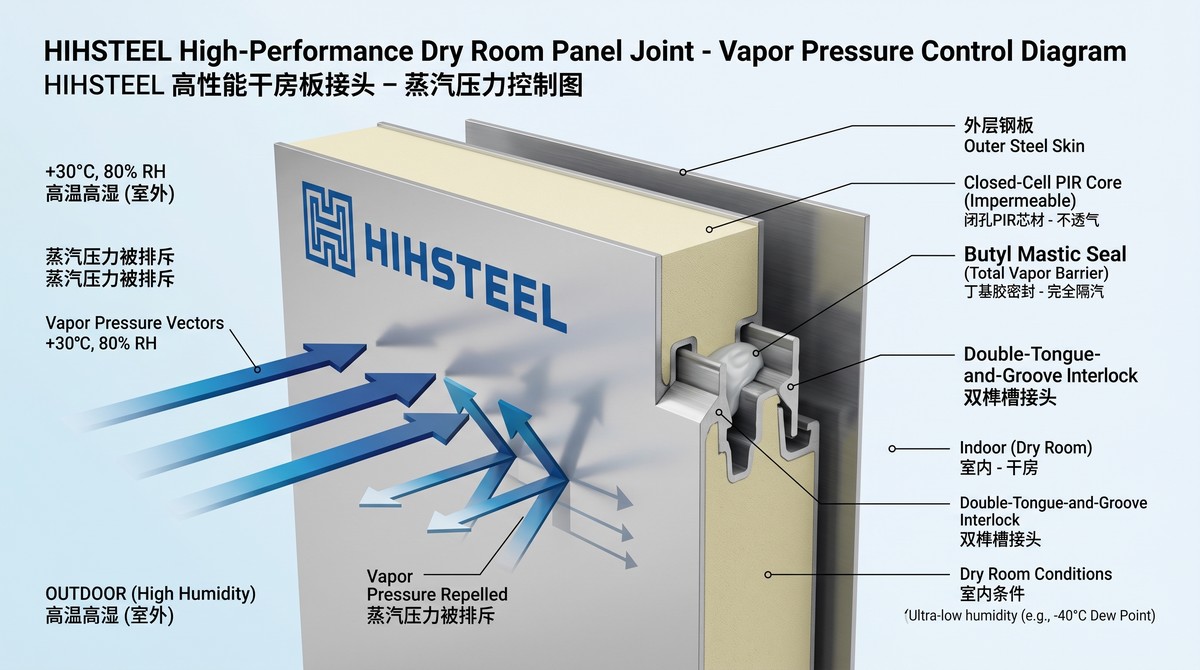
In lithium battery assembly, water vapor is a hazardous chemical catalyst. When moisture molecules in ambient air come into contact with lithium hexafluorophosphate (LiPF₆) in liquid electrolytes, an immediate exothermic hydrolysis reaction occurs, producing toxic and corrosive hydrofluoric acid (HF). This chemical byproduct degrades battery energy density, corrodes cell casing terminals, and presents severe life-safety risks. Because the vapor pressure differential between humid ambient outdoor air (+30°C, 80% RH) and an ultra-dry room (-50°C dew point) exceeds several kilopascals, water vapor violently attempts to migrate through the slightest architectural micro-gap.
Maintaining this extreme moisture deficit requires an impermeable vapor-barrier building envelope. Standard drywall or single-seal mineral wool panels fail completely: open fibrous cores act as moisture sponges, transferring ambient humidity inside and forcing mega-ton desiccant dehumidification wheels to run at emergency capacities. Engineered Polyisocyanurate (PIR) Dry Room Panels resolve this through a continuous high-density closed-cell PIR core (closed-cell ratio ≥ 95%, water absorption ≤ 1.0% by volume) permanently laminated between double-sided continuous galvanized steel facings (thickness 0.6 mm to 0.8 mm).
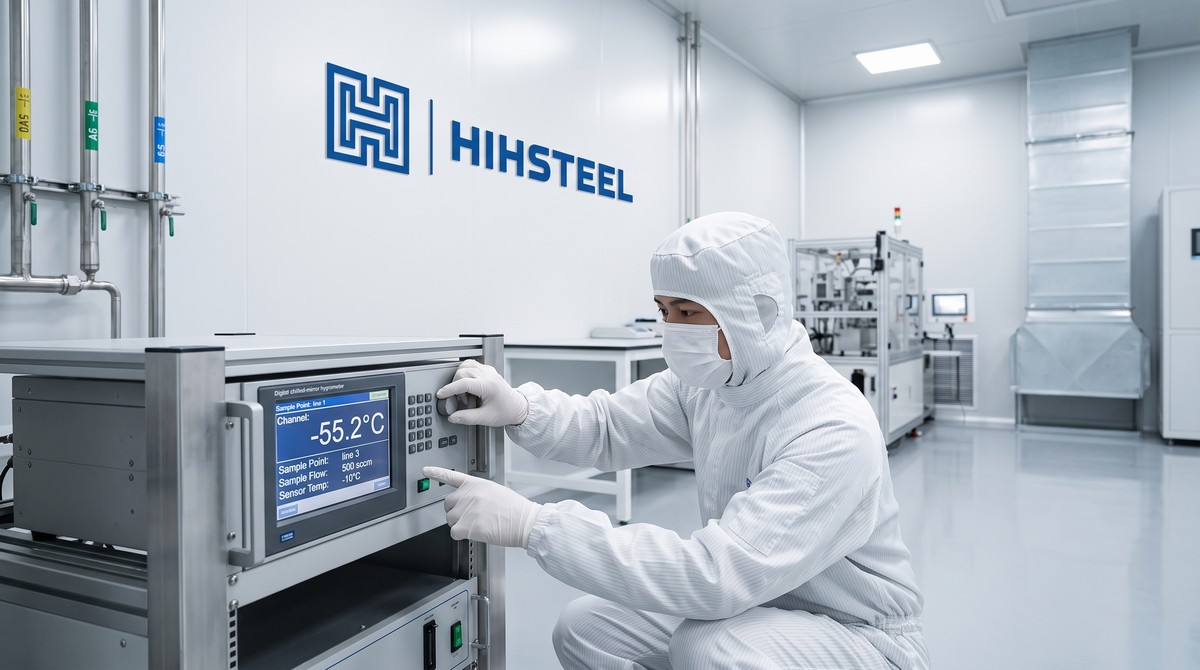
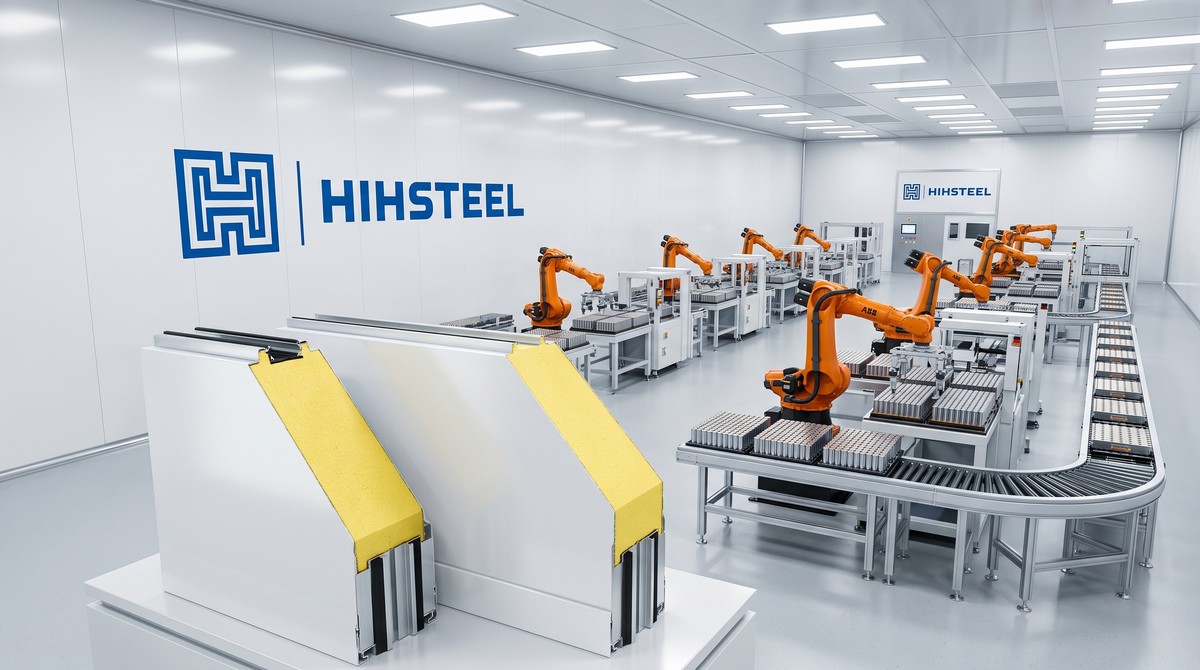
Hermetic envelope integrity is secured by multi-barrier joint geometry. Available from the Hihsteel Clean Room Series, dry room panels feature deep, precision-formed double tongue-and-groove side splines pre-injected with continuous dual elastomeric compression gaskets and non-curing vapor-seal butyl tracks. When clamped tightly into leveled aluminum floor tracks, the panels achieve a water vapor permeance rating under 0.001 Perms (ASTM E96). This impenetrable vapor barrier prevents moisture migration, stabilizes sub-zero dew points, and slashes industrial desiccant dehumidification energy consumption by up to 35%, ensuring high-yield, safe battery production.
Frequently Asked Questions (Top 5 Google Search Q&As):
Q: Why do EV lithium battery dry rooms require an ultra-low dew point of -50°C to -60°C?
A: Water vapor chemically reacts with lithium hexafluorophosphate (LiPF₆) in liquid battery electrolytes to produce hydrofluoric acid (HF)—a toxic and highly corrosive compound. HF corrodes precision equipment, triggers battery cell gas swelling, and causes internal short circuits. Maintaining continuous dew points below -50°C (relative humidity < 0.5%) prevents this hydrolysis reaction and ensures long-term battery cell safety and high energy density.
Q: What water vapor permeance rating is required for battery dry room envelope panels?
A: Standard industrial building panels typically permit 0.1 to 1.0 Perms of vapor transfer, which would quickly overwhelm dry room dehumidifiers. Battery dry room panels must achieve a water vapor permeance rating ≤ 0.001 Perms (tested per ASTM E96). Continuous thick steel facings (0.6mm–0.8mm) combined with high-density closed-cell PIR foam act as a complete, impermeable moisture vapor barrier.
Q: Why is high-density closed-cell PIR preferred over rock wool for battery gigafactory dry rooms?
A: Although rock wool offers excellent fire resistance, its open fibrous matrix acts as a vapor sponge under the massive vapor pressure difference between humid outdoor ambient air (+30°C, 80% RH) and a -50°C dry room. Closed-cell PIR foam (closed-cell ratio ≥ 95%) has near-zero water vapor absorption, preventing moisture migration through the core and saving facility operators 30% to 40% in industrial desiccant dehumidifier electricity consumption.
Q: How are sandwich panel joints sealed to maintain an impenetrable vapor barrier under extreme vapor pressure?
A: Dry room panels utilize deep double-nested tongue-and-groove joint profiles. During installation, two continuous beads of non-curing butyl vapor-barrier mastic and closed-cell elastomeric EPDM compression gaskets are applied along both the inner and outer joints. When clamped into leveled aluminum perimeter channels, the joint creates a dual hermetic seal that completely blocks vapor migration.
Q: Can battery dry room sandwich panels withstand exposure to NMP chemical solvent vapors?
A: Yes. During cathode slurry preparation and coating, N-Methyl-2-pyrrolidone (NMP) solvent vapors are present. Factory-applied coil coatings utilizing High-Durability Polyester (HDS) or 70% Kynar 500 PVDF fluorocarbon finishes withstand airborne NMP exposure and regular chemical cleaning without softening, peeling, or surface discoloration.