In commercial cold storage logistics, quick-freeze blast tunnels (-35°C), and automated refrigerated distribution centers, energy consumption accounts for upwards of 60% to 70% of total operational expenditure. The primary culprit behind surging electricity bills, compressor cycling overload, and ice accumulation on internal surfaces is thermal bridging—conductive heat bypass pathways occurring at panel joints, fastener penetrations, and wall-to-floor junctions.
As thermal engineering data from hihsteel demonstrates, continuous insulation integrity mandated by ASHRAE Standard 90.1 cannot be achieved with conventional EPS (Expanded Polystyrene) or unsealed mineral wool boards. PIR (polyisocyanurate) sandwich panels achieve an industry-leading thermal conductivity of λ ≤ 0.022 W/m·K at 10°C mean temperature, offering more than double the insulating efficiency of fibrous insulation. A 150mm PIR panel delivers an impressive thermal resistance of R-value > 38.6 hr·ft²·°F/Btu (U-value < 0.147 W/m²·K), allowing facility owners to maintain sub-zero temperatures with significantly smaller refrigeration chiller footprints.
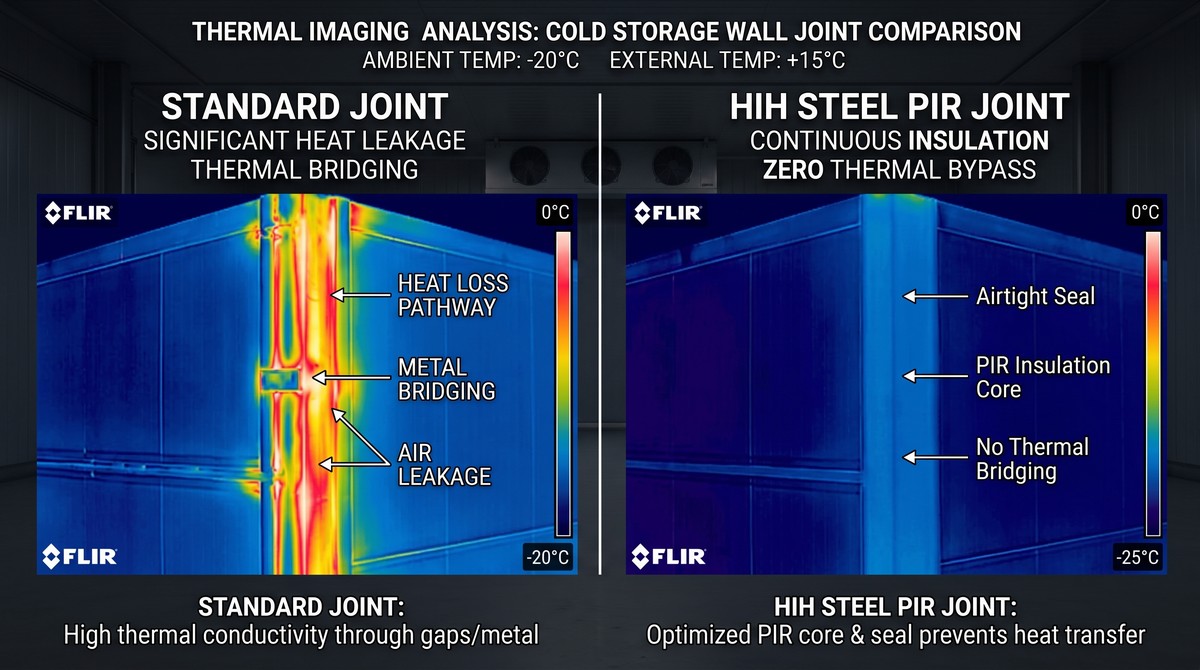
However, a high core R-value is rendered ineffective if panel joints leak air and vapor. In high-humidity outdoor environments, ambient warm air seeks the low-pressure cold zone inside the warehouse. When moisture penetrates joint gaps, it condenses into water droplets, freezes into ice wedges, and progressively delaminates the panel face from the core—a catastrophic failure mechanism known as vapor drive frost heave. To prevent this, HIHSteel engineers precision-milled multi-lip double tongue-and-groove joint geometries equipped with factory-injected closed-cell elastomeric butyl seals and PVC thermal break inserts.
By eliminating through-metal contact and air migration pathways across every panel junction, HIHSteel PIR cold room panels create an unbroken vapor barrier with a water vapor transmission rate of less than 0.05 perm. Field testing on automated high-bay cold warehouses proves that eliminating joint thermal bridges reduces compressor cooling loads by 30% to 40% annually, while preventing surface condensation and mold colonization in full compliance with USDA and HACCP sanitary food guidelines.
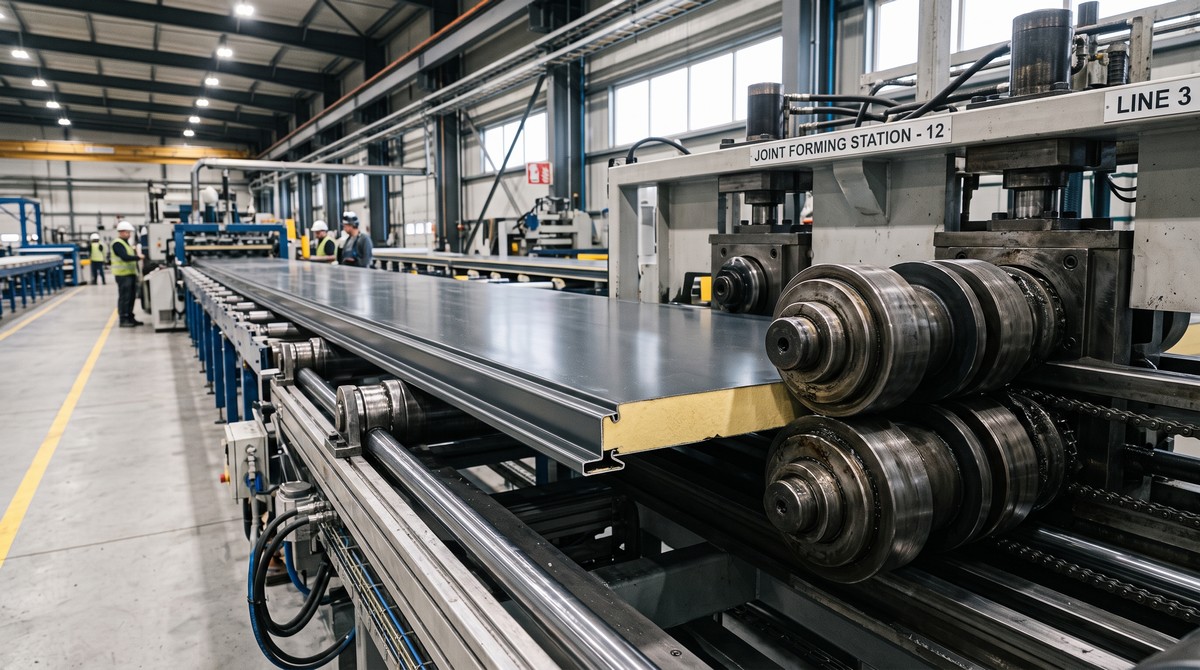
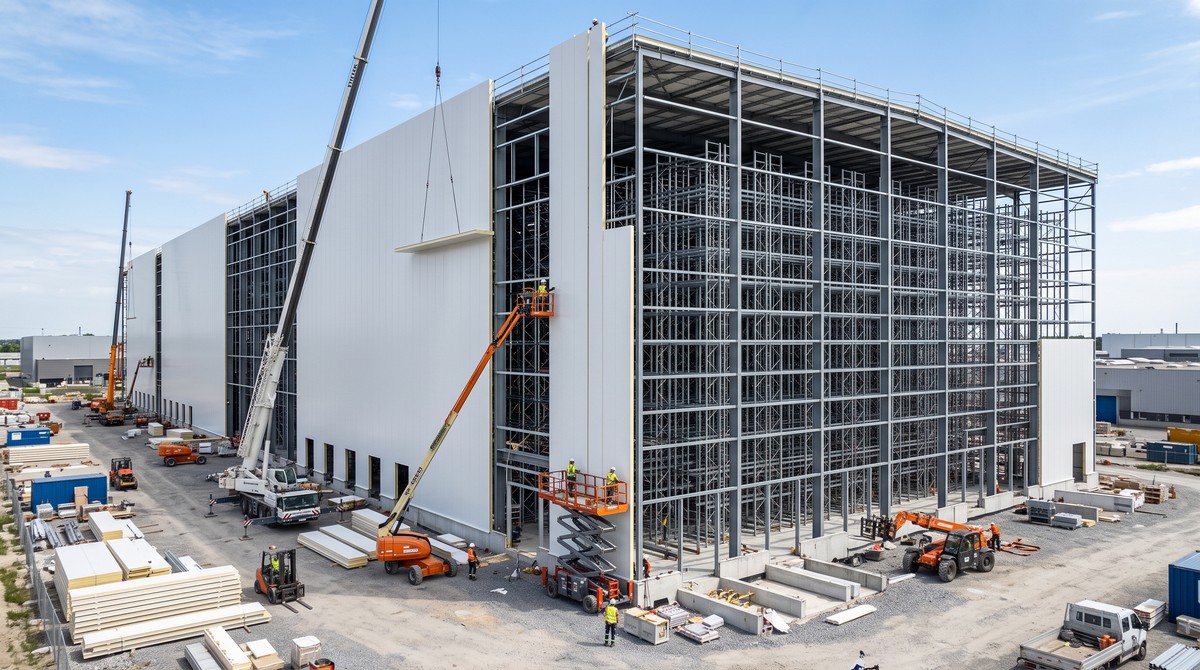
Whether specifying modular cold walk-in freezers with integrated eccentric cam-locks or continuous 18-meter-tall automated clad-rack refrigerated distribution walls, HIH Steel provides customized skin thicknesses (0.5mm to 0.8mm) in food-safe antibacterial plastisol or 304/316L stainless steel finishes. Calculate your cold room thermal envelope requirements and request factory-direct quotations at hihsteel.com.
Thermal Envelope Comparison: PIR vs. Conventional Cold Storage Insulation
| Insulation / Joint Parameter | HIH Steel PIR Continuous Panel | Conventional EPS Panel | Operational & Financial Impact |
| Thermal Conductivity (λ) | ≤ 0.022 W/m·K | 0.038 – 0.042 W/m·K | PIR requires 45% less thickness to achieve identical thermal insulation |
| Joint Design Architecture | Multi-lip double tongue & groove + PVC break | Single flat tongue or butt joint | Completely eliminates convective air leakage and condensation icing |
| Closed-Cell Foam Content | > 95% closed-cell structure | Open inter-bead voids | Prevents moisture absorption and vapor drive degradation over decades |
| Compressor Energy Consumption | Baseline (Lowest chiller kWh demand) | +35% to +45% higher electrical load | Saves tens of thousands of dollars annually in commercial cold storage power |
| Sanitary Compliance | USDA, HACCP & FDA food contact approved | Vulnerable to interior joint mildew | Ensures pristine hygienic environments for meat, dairy, and pharmaceuticals |
| Core Density Range | 40 – 45 kg/m³ high-pressure foam | 18 – 25 kg/m³ expanded beads | Superior compressive strength (≥ 220 kPa) under sub-zero thermal cycling |
| Fire Performance | B1 / Class 1 / ASTM E84 Class A | B2 / B3 (Melts rapidly under flame) | PIR chars and self-extinguishes, drastically reducing facility fire risk |