Why Paint Resin and Metallic Substrate Dictate Outer Skin Life
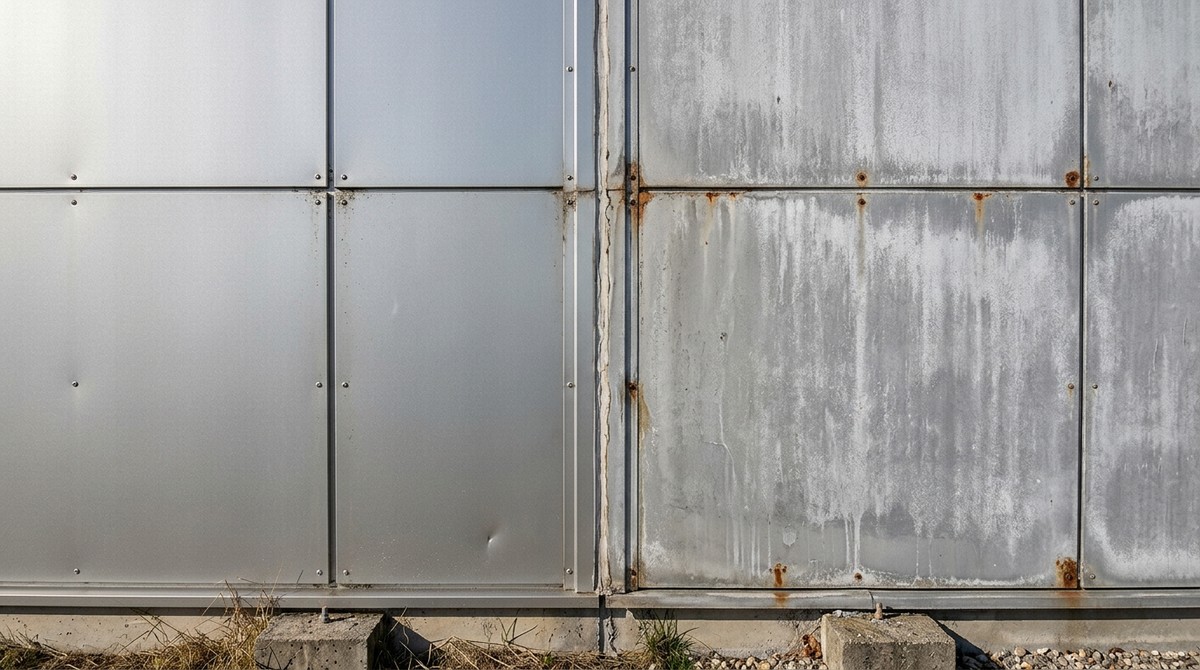
Well-specified insulated sandwich panels routinely last 30 to 40 years on commercial factories ([PanelSandwich Durability Guide]). Yet every industrial park has at least one ten-year-old warehouse with faded pink walls and rusty roof eaves. What separates a 12-year failure from a 35-year asset?
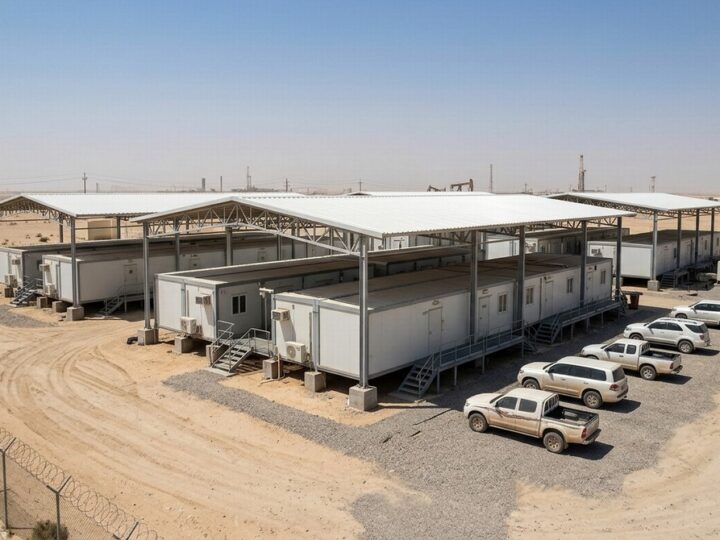
Outer steel sheets face two enemies: ultraviolet solar photons that snap polymer chains in the paint, and moisture that oxidizes the bare steel underneath. Standard polyester (PE) paint costs the least, and inside a mild European climate it holds up for 12 to 15 years before surface chalking starts. Put that same 18-micron PE paint on a roof in Dubai, Chile, or coastal Vietnam, and intense UV breaks down the resin in six years. Upgrading the topcoat on our sandwich roof panels to High-Durability Polyester (HDP) or 70% PVDF fluorocarbon paint over an AZ150 Galvalume or Z275 galvanized base sheet pushes corrosion resistance past 30 years ([Rauta Group Lifespan FAQ]).
| Coating & Substrate System | Core Material | Inland Industrial Lifespan | Coastal / High-UV Lifespan | Chalking & Fade Resistance |
| PE (18-20 um) on Z100 GI Steel | EPS (12-15 kg/m3) | 10 – 15 Years | 5 – 8 Years | Basic (Chalks in 5-7 yrs) |
| PE (20-22 um) on Z180 GI Steel | Rock Wool (100 kg/m3) | 15 – 22 Years | 8 – 12 Years | Moderate |
| HDP (25 um) on Z275 / AZ150 Steel | PIR / PU (40 kg/m3) or Rock Wool (120 kg/m3) | 25 – 30 Years | 18 – 22 Years | High (15-yr color stability) |
| PVDF 70% Kynar (25-28 um) on AZ150 | PIR (42 kg/m3) or PU-Sealed Rock Wool | 35 – 40+ Years | 25 – 30+ Years | Superior (20-yr UV warranty) |
Core Longevity: Closed-Cell PIR vs Unsealed Rock Wool vs EPS
Steel skins rarely fail alone. Often, the insulation core loses structural stiffness or absorbs water first.
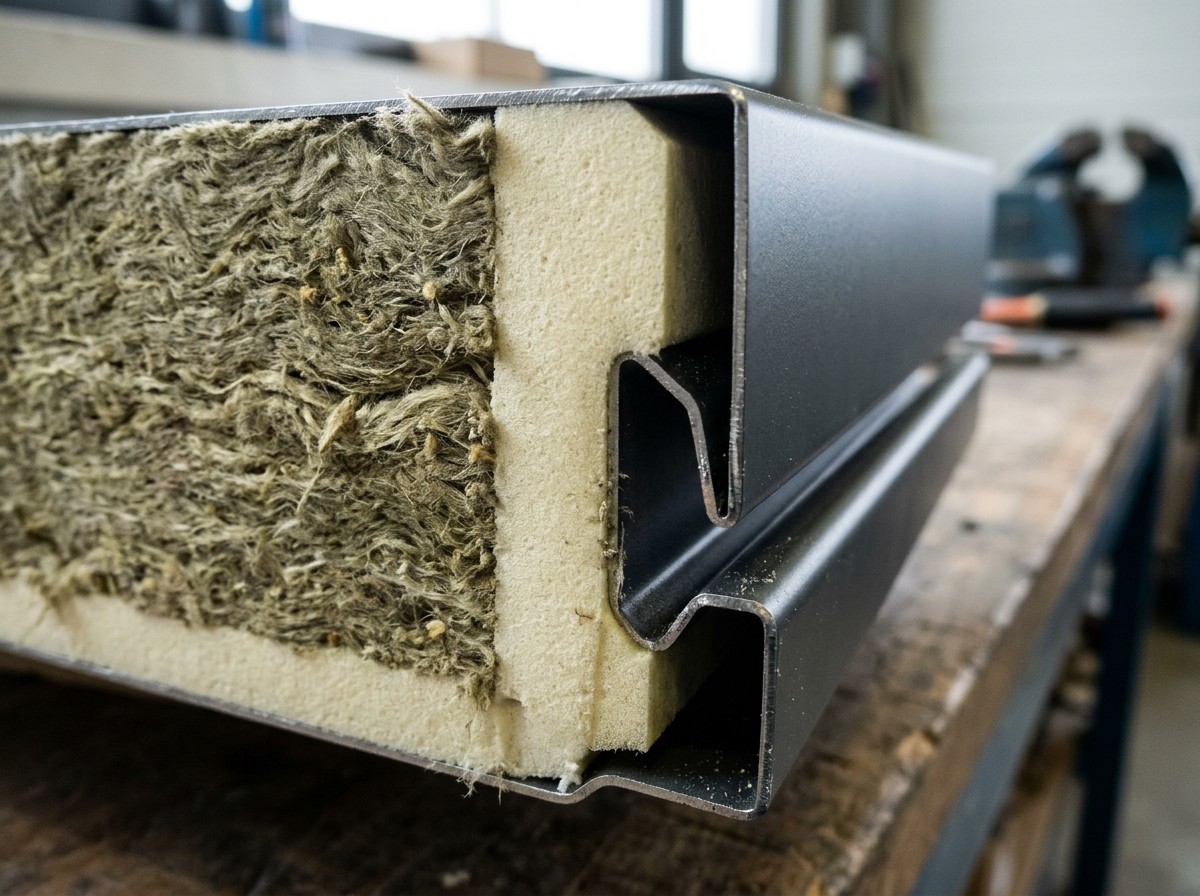
Closed-cell rigid polyisocyanurate (PIR) and polyurethane (PU) foam cores moulded at 40 to 42 kg/m³ contain over 93% closed cells. Because moisture vapor cannot migrate through closed cells, a PIR panel retains more than 90% of its original thermal resistance after 25 years of continuous operation. Basalt rock wool cores never burn or shrink over 50 years, but unsealed mineral wool has one weakness: if rainwater leaks through a bad roof joint or open gable trim, wet wool gets heavy and loses bond strength. That is why our long-life rock wool wall panels use hydrophobic basalt fibers (>= 98% water-repellent rate) or polyurethane side-sealing that locks moisture out of the longitudinal joints.
Cut-Edge Rust and Fastener Washers: The Real Weak Links
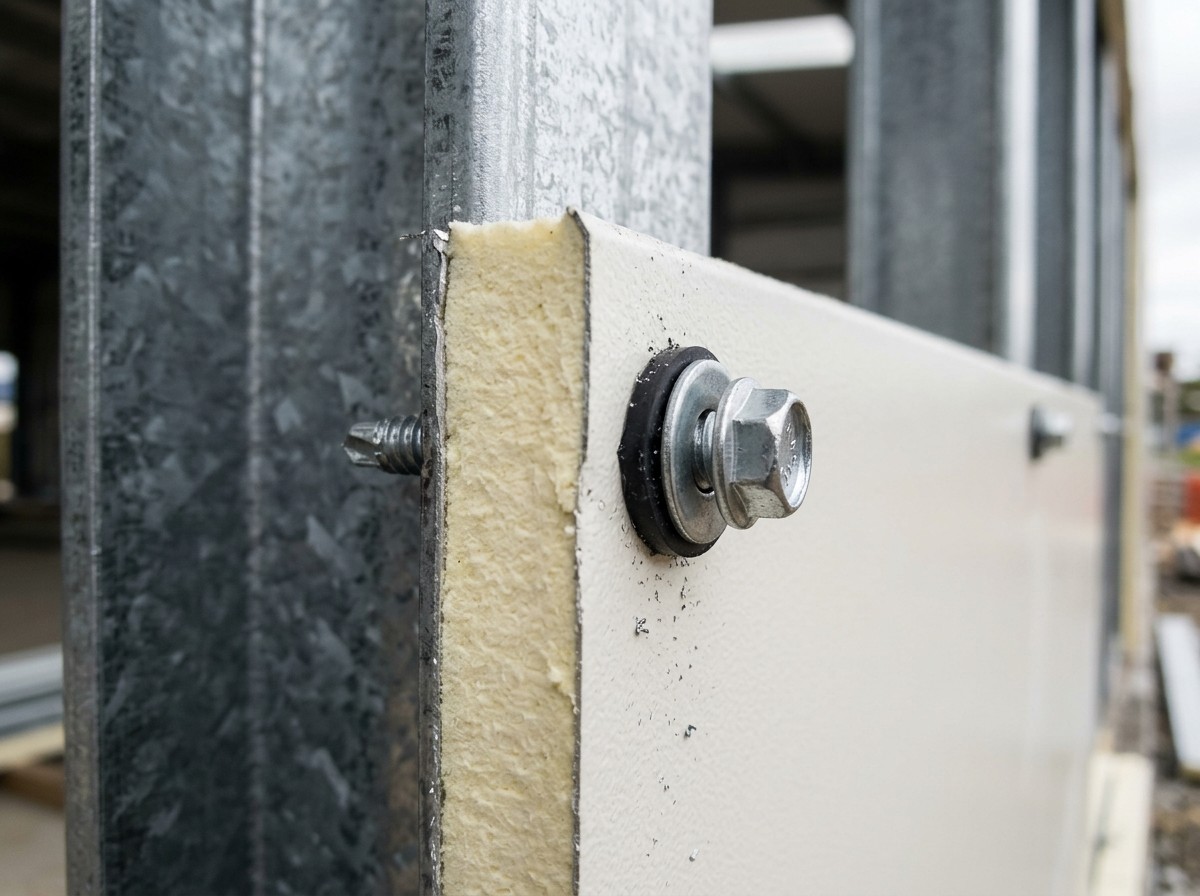
When a 25-year sandwich panel wall finally needs refurbishment, the flat center of the panel almost always looks spotless. Corrosion starts at the cut edges and screw holes.
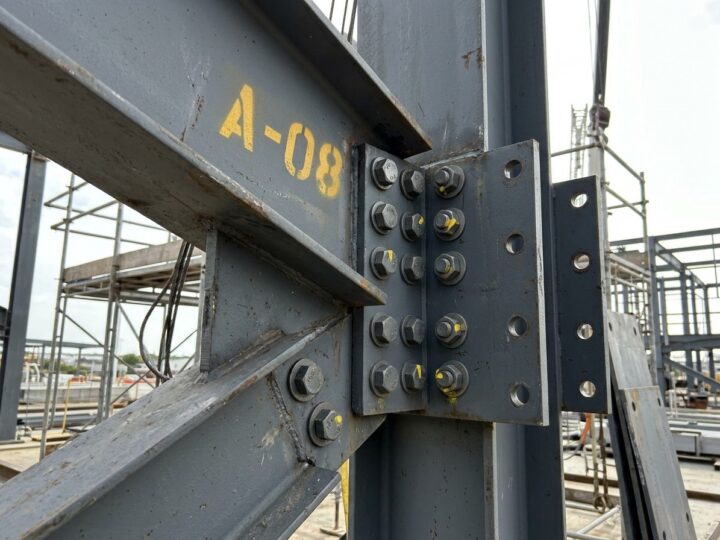
Factory coil-coated sheets have galvanic zinc protection across the flat faces, but every eave drip edge, window cutout, and site-trimmed gable exposes a raw 0.5mm steel edge to rain. If installers cut panels with a high-speed abrasive grinder instead of a cold shear or circular saw, heat burns off the surrounding zinc layer within 10 millimeters of the cut, triggering cut-edge peel back within three years. Second, cheap carbon-steel screws with low-grade rubber washers crack after eight summers of UV exposure. Specifying Class 3 or Class 4 mechanically galvanized or bimodal 304 stainless steel fasteners with genuine UV-stabilized EPDM washers ensures your screws last as long as your sandwich wall panels.
Frequently Asked Questions (FAQ)
Q1: How long do PIR and PU sandwich panels keep their insulation value?
A: Because high-density PIR and PU panels have a >93% closed-cell structure wrapped in impermeable steel skins, gas diffusion is negligible and the panels maintain their rated thermal performance for 30 to 40+ years.
Q2: Does rock wool insulation inside a sandwich panel sag over time?
A: Not when manufactured at structural cladding densities of 100 to 140 kg/m³ with vertical fiber lamella orientation bonded to both steel skins with two-component polyurethane adhesive.
Q3: Can you repaint old faded sandwich panels to extend their life?
A: Yes. If the core bond is still tight and there is no structural delamination, pressure-washing the chalked PE surface, priming bare spots with epoxy primer, and spraying an elastomeric polyurethane facade coating adds 10 to 15 years of service life.
Q4: Why do dark-colored sandwich panels age faster than white or silver panels?
A: Dark colors (such as RAL 7016 anthracite or RAL 3000 red) absorb far more solar radiation, heating the outer metal skin up to +75°C or +80°C. That daily thermal expansion and contraction stresses both the paint resin and the adhesive bond line.
Q5: How often should sandwich panel joints and sealants be inspected?
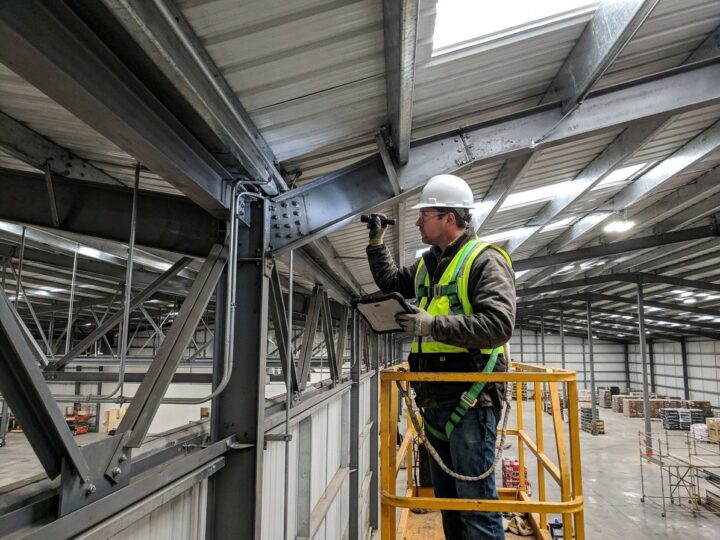
A: Inspect roof ridge flashings, gutter laps, and window perimeter silicone sealants every 2 to 3 years, and re-caulk any UV-cracked external sealant beads around penetrations at the 10-year mark.