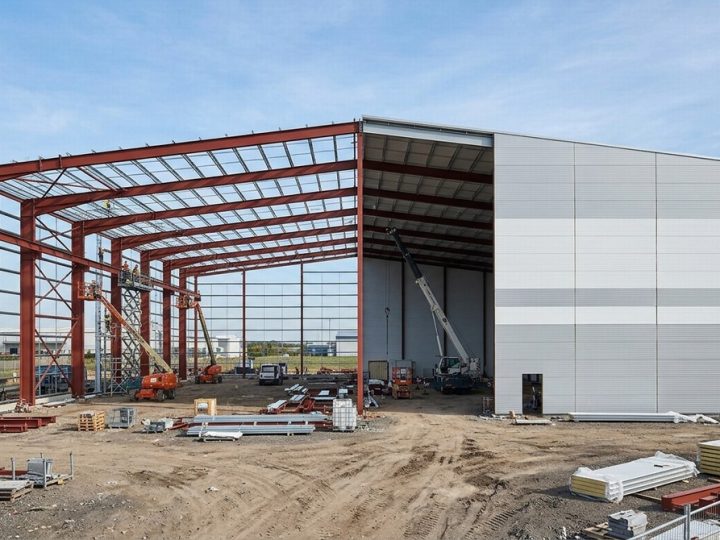
A 240mm brick wall weighs about 190 kg per cubic meter. Put that on a 10-meter-tall factory frame and your structural engineer has to upsize every H-beam column and pour deeper concrete footings just to hold the walls up. A 100mm EPS sandwich wall panel weighs 10.9 kg per square meter. Even a 100mm fire-rated rock wool board with 0.6mm steel skins sits around 21.2 kg per square meter.
Weight changes the steel math right away. Less mass. Smaller footings. When the ground shakes slightly, lighter walls pull much less on the main portal frame, and your engineer can space the secondary C-girts further apart without worrying about column buckling.
| Panel Type & Thickness | Weight (kg/m²) | Heat Transfer (W/m²·K) | Max Span at 1.0 kN/m² (m) |
| 50mm EPS Wall / Roof Panel | 10.0 kg/m² | 0.64 W/m²·K | 5.0 – 5.1 m |
| 100mm EPS Wall / Roof Panel | 10.9 kg/m² | 0.32 W/m²·K | 7.5 – 7.6 m |
| 100mm Rock Wool Wall Panel | 21.21 kg/m² | 0.41 W/m²·K | 4.58 m |
| 100mm PIR Insulated Panel | 13.5 kg/m² | 0.21 W/m²·K | 6.2 – 6.8 m |
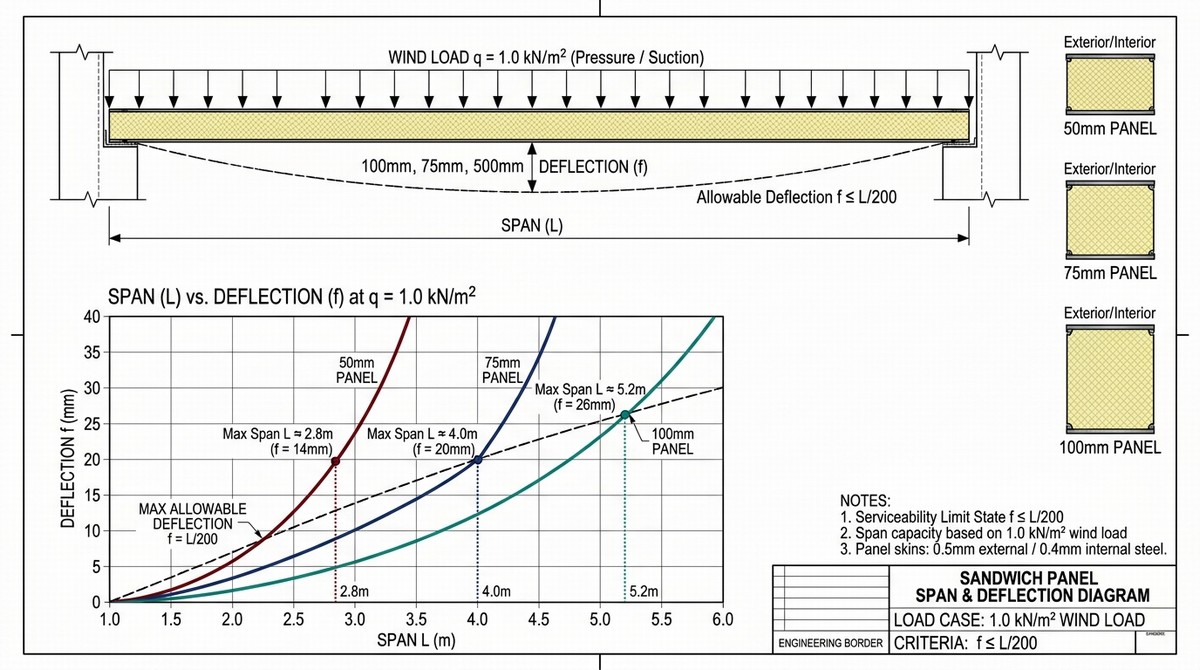
Under an allowable deflection limit of f <= L/200 and a wind load of 1.0 kN/m², a 100mm EPS wall panel spans up to 7.6 meters between supports, while a 100mm rock wool wall panel (/product/high-quality-rock-wool-sandwich-panel-for-exterior-wall-insulation/) safely covers 4.58 meters. In most real warehouses we build at Hihsteel, contractors space wall girts at 2.0 to 3.0 meters to keep a wide safety margin in storm zones.
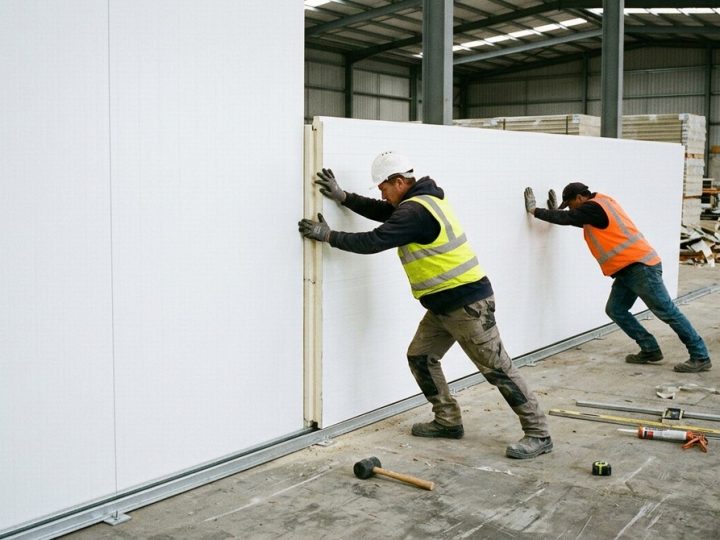
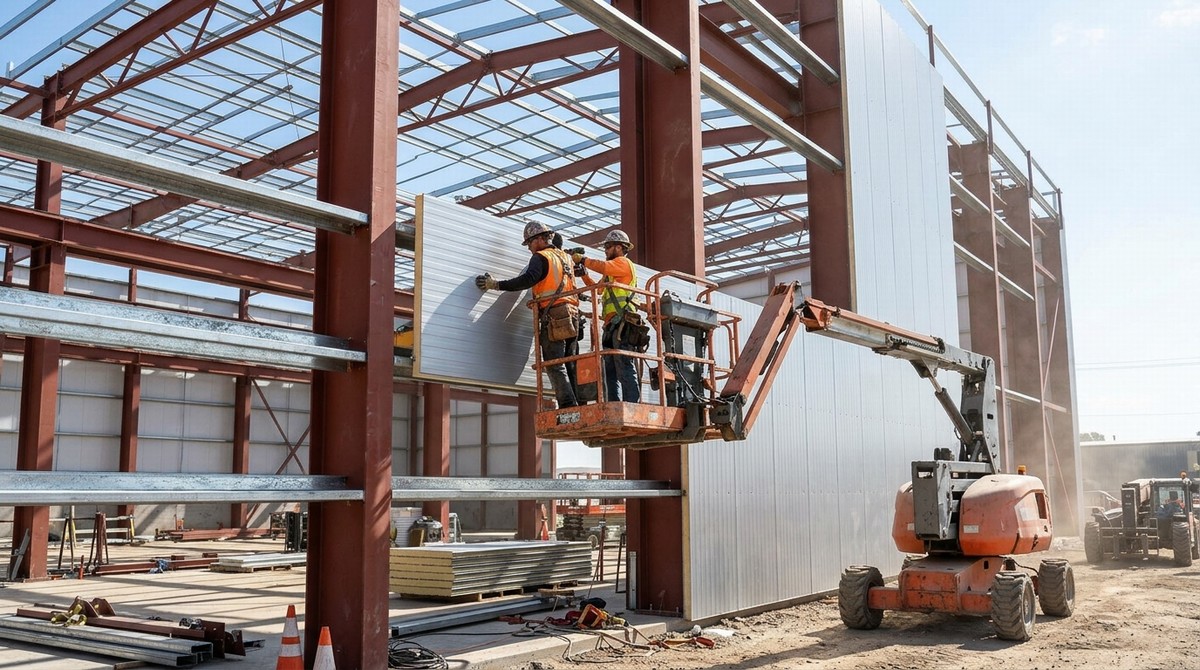
On-site labor is the other reason contractors switched. Traditional walls need four separate trades: masons to lay block, roofers to hang outer sheets, insulators to stuff mineral wool, and painters to finish the inside. A sandwich panel comes off our continuous double-crawler line with both galvanized steel skins already roller-coated and bonded to the core. Two workers and a small crane lift the board, slide the H-socket or S-socket edges together, and run self-drilling screws into the steel girt. A job that used to take ten weeks of wet work wraps up in three.
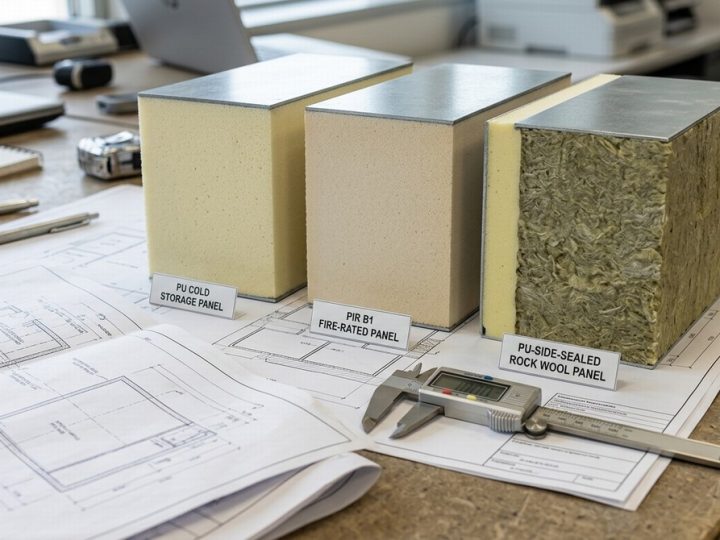
Different workshops need different cores, so we rarely quote just one board for an entire industrial park. Chemical plants and paint shops use Class A rock wool (rated up to 800°C) because fire inspectors require 60 to 120 minutes of fire resistance. Cold logistics hubs use PIR or PU cores with thermal conductivity between 0.020 and 0.024 W/(m·K). Dry machinery workshops in Mexico and Canada often run 75mm EPS roof panels to keep material costs down around $9 to $14 per square meter.
Frequently Asked Questions (FAQ)
Q: How much structural steel does a sandwich panel building save compared to brick or precast concrete?
A: Because sandwich panels weigh only 10 to 26 kg/m² (roughly 1/8th to 1/10th the weight of masonry or precast concrete), primary steel column and foundation loads drop by 15% to 20% on standard single-story industrial plants.
Q: What is the standard effective width of industrial wall and roof sandwich panels?
A: Wall sandwich panels are typically roll-formed in effective widths of 950mm, 1,000mm, or 1,150mm. Roof sandwich panels use 950mm or 980mm effective widths in either Cap-Type or Overlap-Type rib profiles.
Q: How long can a single sandwich panel be cut at the factory?
A: Production lines can cut any custom length from 400mm up to 12 meters, though export orders are capped at 11.80 to 11.90 meters so bundles fit inside a 40-foot High Cube shipping container.
Q: Do sandwich panels provide enough sound insulation for noisy machinery workshops?
A: Yes. A 75mm to 100mm rock wool or EPS sandwich wall panel blocks 40 to 45 dB of airborne sound. For heavy stamping or generator rooms, perforated acoustic rock wool panels absorb internal echo.
Q: What steel skin thickness should I specify for a factory wall?
A: Most industrial wall panels use 0.50mm or 0.60mm outer steel skins and 0.40mm to 0.50mm inner skins. Coastal or high-wind buildings often step up to 0.60mm–0.80mm PPGL (Aluzinc) or PVDF-coated steel.