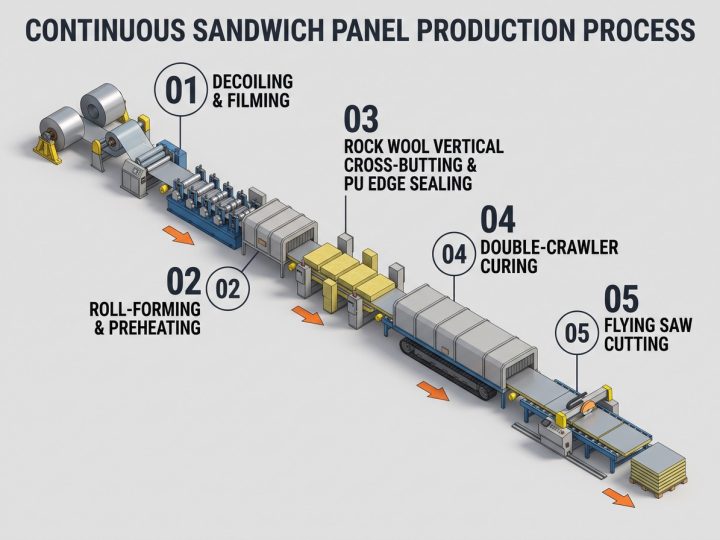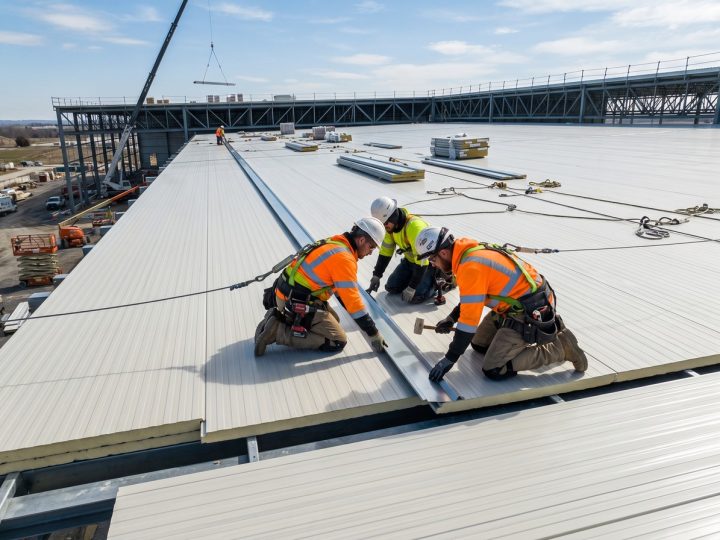
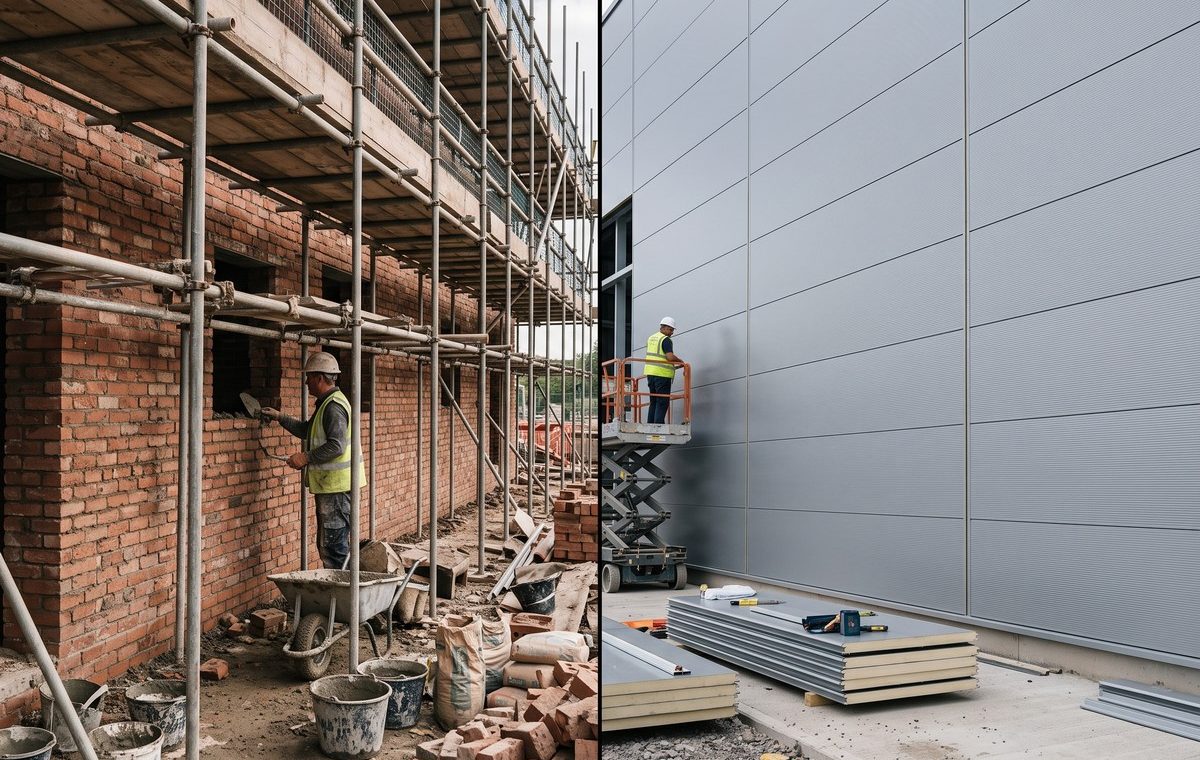
Imagine wearing a heavy stone coat in the middle of winter. It weighs a ton, wears out your knees, and still lets the freezing wind right through to your skin. Now imagine swapping that stone coat for a featherweight down jacket. That is the exact difference between building a factory with traditional brick walls and building it with modern sandwich wall panels.
For decades, builders laid bricks because bricks were cheap and familiar. But on a modern industrial project, brick walls quietly eat your budget from three directions at once: heat loss, foundation weight, and labor time.
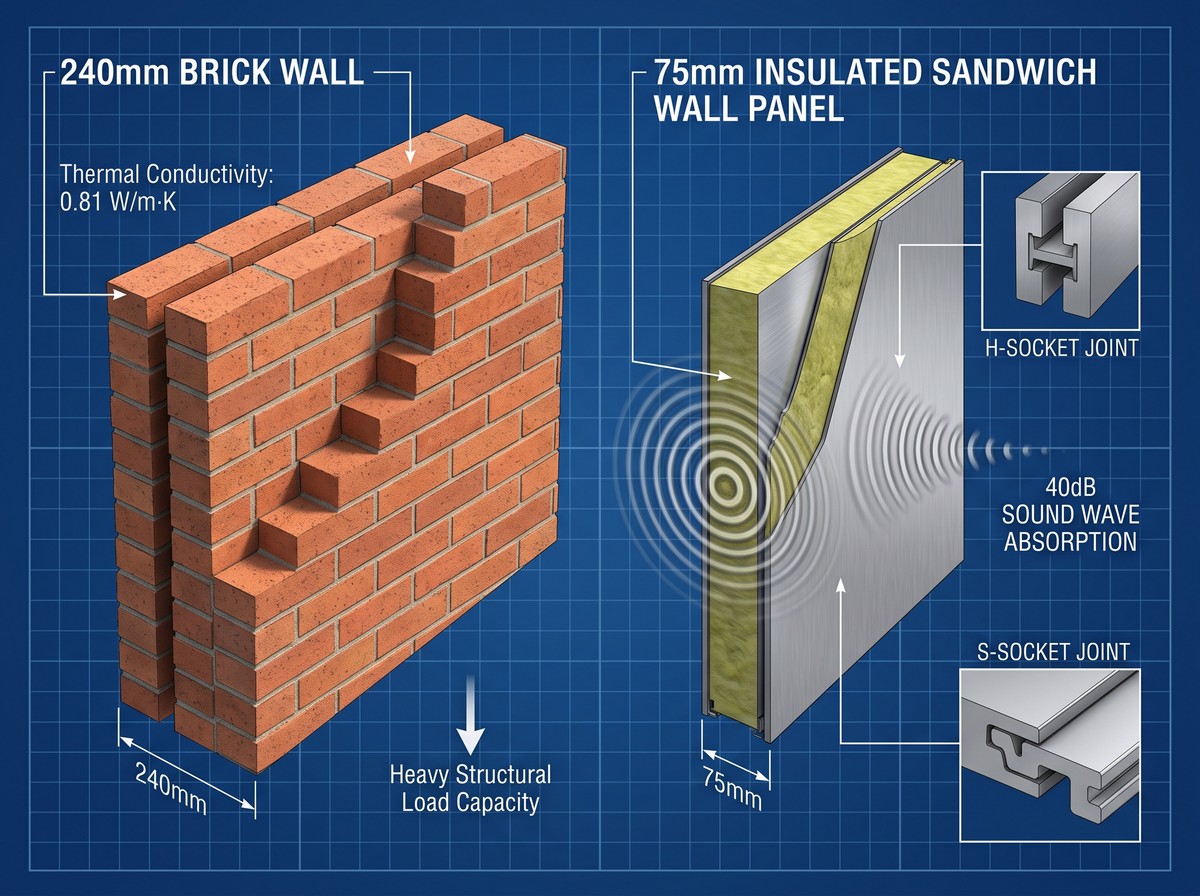
| Key Building Metric | Traditional Brick Wall (240mm) | Insulated Sandwich Wall Panel (75–100mm) |
| Thermal Conductivity | ~0.81 W/(m·K) (Leaks heat fast) | 0.020 – 0.041 W/(m·K) (Up to 20x better) |
| Structural Weight | ~190 kg/m³ (Needs heavy foundation) | 10 – 26 kg/m² (1/5 to 1/10 of brick weight) |
| Construction Speed | Slow wet masonry + plastering | Shortens build schedule by over 60% |
| Later Maintenance Cost | High (Cracks, mortar peeling, repainting) | Only 1/3 to 1/2 of traditional brick walls |
Start with simple heat physics. A standard clay brick wall has a thermal conductivity of roughly 0.81 W/(m·K). Heat walks right through it. In contrast, an EPS sandwich panel hits 0.030 to 0.041 W/(m·K), and a PU or PIR panel drops all the way to 0.020 W/(m·K). That means a slim 75mm sandwich panel holds indoor temperatures better than a brick wall five times its thickness. Whether you are running a temperature-controlled workshop or trying to cut winter heating bills, the energy math isn’t even close.
Next, look at the weight on your foundation. Brick masonry weighs around 190 kg/m³. When you stack bricks six or八 meters high, your structural engineer has to pour massive concrete beams just to keep the walls from sinking. An EPS core has a density of only 8 to 20 kg/m³, and even a heavy-duty Class A fireproof rock wool wall panel weighs only 15 to 26 kg per square meter. Lighter walls mean lighter steel columns, smaller footings, and safer performance in earthquake zones.
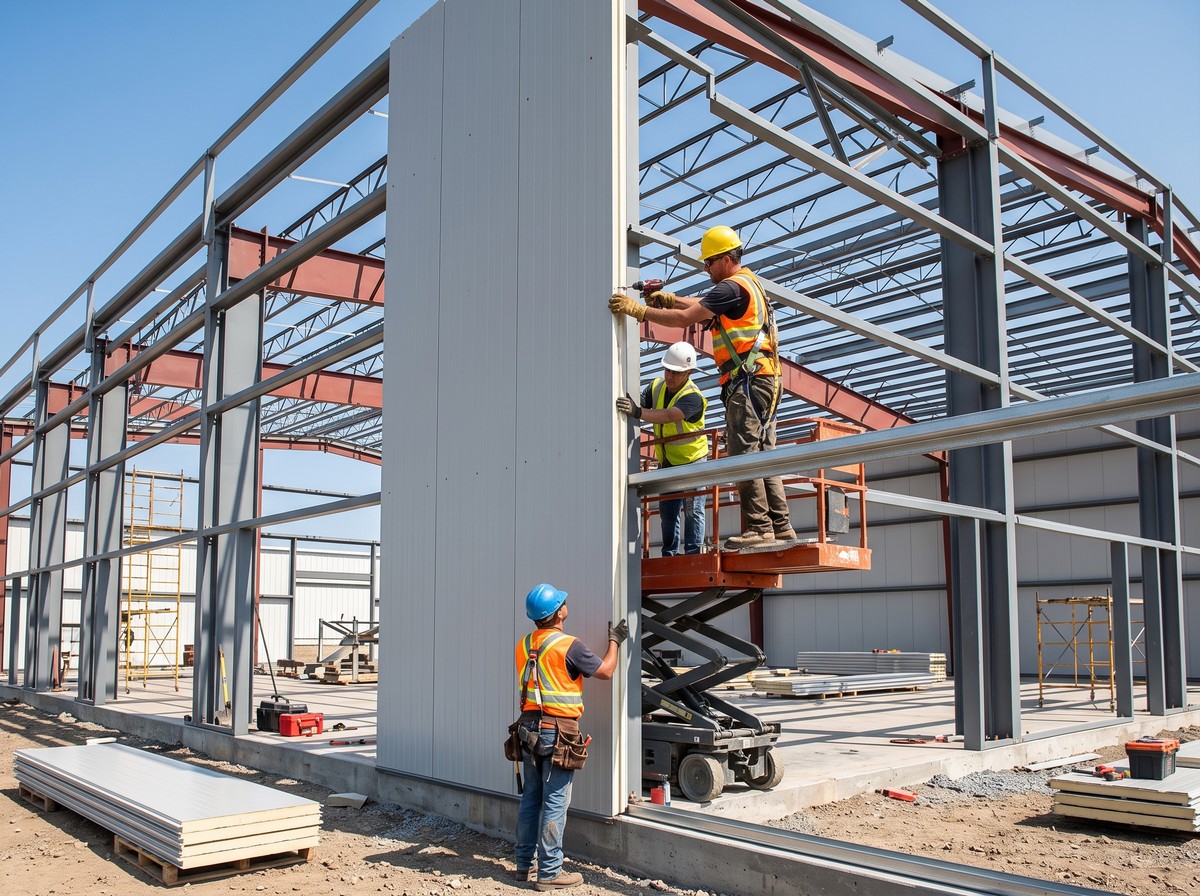
Finally, time is money. Laying bricks requires cement, water, scaffolding, plastering, and weeks of drying. Sandwich panels arrive from the Hihsteel factory pre-cut and pre-painted with H-socket or S-socket tongue-and-groove edges. A small crew of three workers can bolt them onto steel girts and cut your construction period by more than 60%. Over a 20-year lifespan, your maintenance bill is barely one-third of a brick building’s.
Frequently Asked Questions (FAQ)
Q: Do sandwich wall panels block factory noise as well as brick walls?
A: Yes. Both closed-cell honeycomb EPS cores and porous basalt rock wool cores absorb sound waves effectively. A standard sandwich wall panel achieves over 40 dB of airborne sound insulation, and double-layer or high-density rock wool designs push past 45 dB.
Q: Are sandwich panels strong enough to handle wind loads on tall factory walls?
A: Definitely. Because two rigid pre-painted steel sheets (0.4mm to 0.8mm thick) are permanently bonded to the core under high pressure, a 100mm wall panel can safely span 6 to 8 meters vertically while keeping deflection within f ≤ L/200.
Q: What joint types are used for industrial sandwich wall panels?
A: Industrial wall panels typically use H-socket connections or S-socket (concealed tongue-and-groove) connections in effective widths of 950mm, 1000mm, or 1150mm, sealing out rainwater and wind drafts without mortar.
Q: Can sandwich wall panels be reused if we relocate our factory?
A: Yes. When you demolish a brick wall, 100% of it turns into rubble. Because sandwich panels are fixed with bolts and connectors, you can dismantle them when moving or expanding and reuse a large portion of the panels on your next building.
Q: Which sandwich panel core should I pick to replace brick firewall partitions?
A: For fire-rated walls in hospitals, schools, and chemical workshops, choose Class A non-combustible rock wool sandwich panels, which withstand temperatures up to 800°C and provide 60 to 120+ minutes of fire protection.