⚠️ United States Earthquake Fact File
📍 Location: Humboldt County (Ferndale), Northern California, USA
🎚️ Magnitude: Mw 6.4
⏱️ Date: December 20, 2022
💥 Impact: 2 fatalities, severe structural damage to old unreinforced masonry, commercial facilities, utility networks, and bridges across the region.
🏚️ Failure Mode: Older commercial structures failed to absorb the sharp, sudden tectonic forces generated near the Mendocino Triple Junction. Brittle rigid connections fractured violently under cyclic loading.
🏗️ Reconstruction: Strict compliance with US standards, upgrading to AISC 341 Special Moment Frames (SMF) and FM Global/UL 90 certified puncture-free roofing systems capable of surviving extreme structural drift.
Across the western United States, the seismic threat is an urgent, daily operational reality. On December 20, 2022, a Mw 6.4 earthquake struck near Ferndale in Humboldt County, Northern California, causing widespread power outages and severe structural damage to older commercial buildings. From Southern California’s San Andreas fault system to the Pacific Northwest’s Cascadia Subduction Zone, structural engineers and industrial facility developers are preparing for massive tectonic events.
In modern distribution centers, automated semiconductor cleanrooms, and aerospace logistics facilities, standard “life-safety” building survival is not enough. Investors, property developers, and global insurers demand absolute compliance with strict seismic building standards (AISC 341 and ASCE 7-22). This requires structural systems that prevent frame collapse while simultaneously keeping facilities completely weather-tight and fully operational post-earthquake.
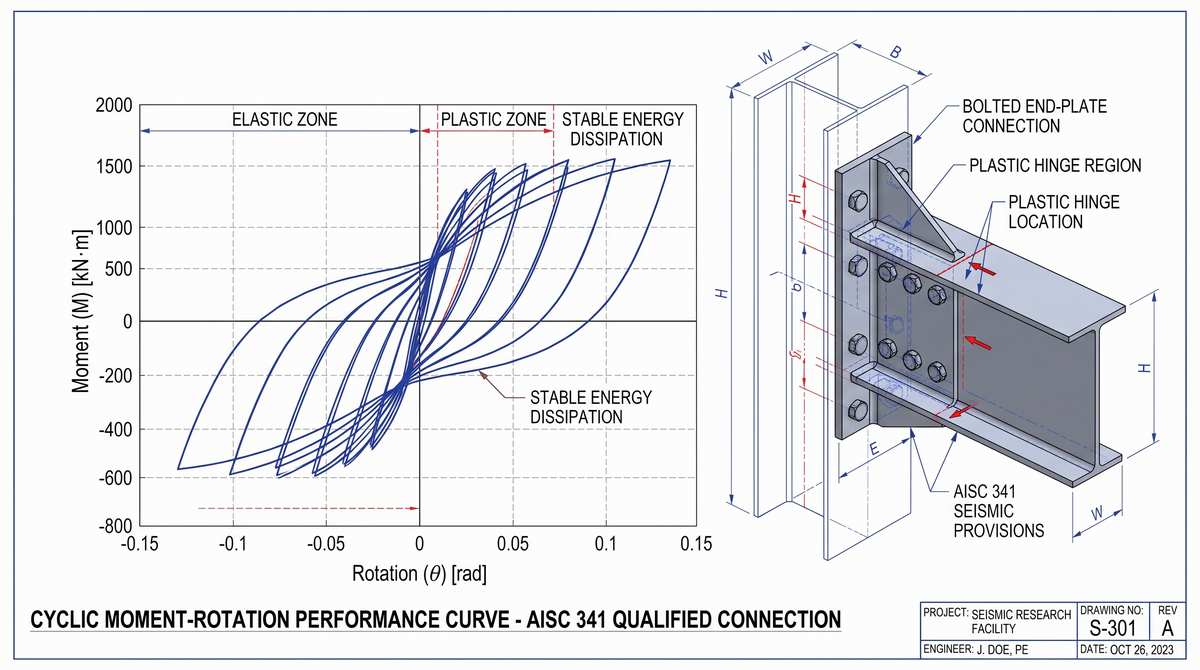
We manufacture advanced Pre-Engineered Steel Buildings fully certified to AISC 360 (Specification for Structural Steel Buildings) and AISC 341 (Seismic Provisions for Structural Steel Buildings). To achieve true Special Moment Frame (SMF) performance, our Q345B/ASTM A572 Grade 50 steel portal frames incorporate precision-engineered moment connections detailed with Grade 10.9S high-strength pre-tensioned bolts.
Under dynamic cyclic seismic ground motion, these heavy-duty connections form stable, predictable plastic hinges that dissipate massive amounts of seismic energy through material hysteretic damping. Combined with diagonal flange braces bolted at 45° angles directly into continuous cold-formed purlins, our structural framing completely prevents rafter lateral-torsional buckling, safely absorbing lateral drift ratios exceeding 0.025 h.
Equally critical for high-value industrial operations is safeguarding the interior against water intrusion following an earthquake. Traditional industrial metal roofs rely on thousands of penetrative self-drilling screws. During a major seismic event, the differential sway between adjacent steel frames shears these screws off, ovalizes the fastener holes, and tears the roof sheets. This allows torrential rain and snowmelt to pour in, destroying high-value inventory and sensitive machinery.
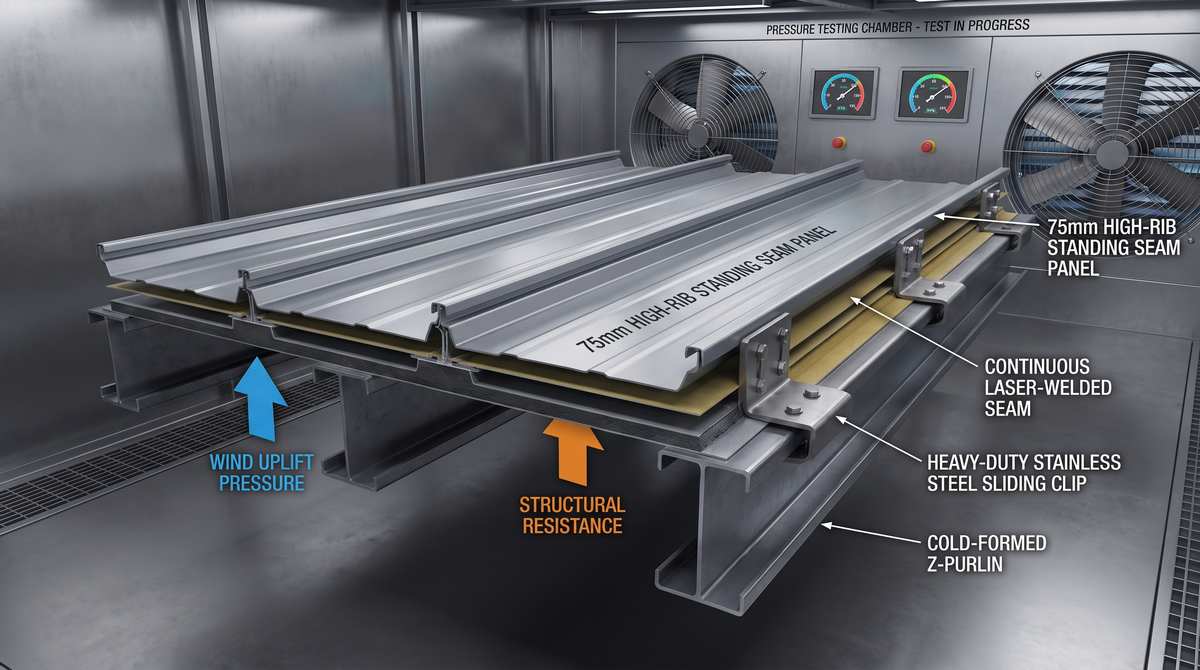
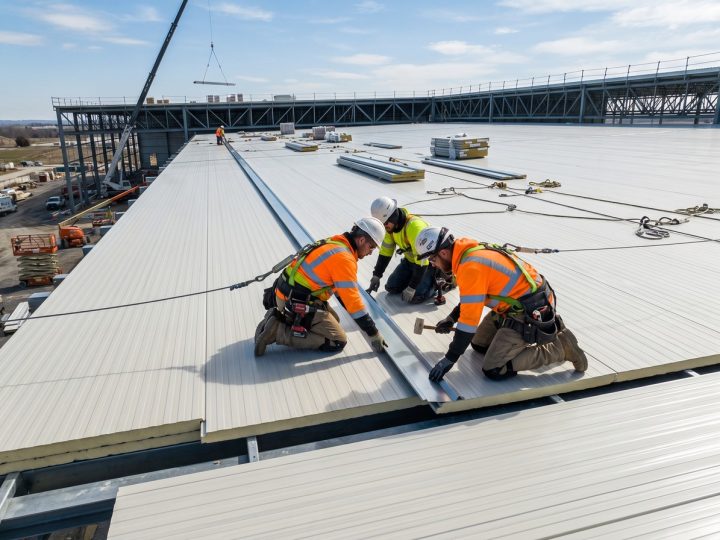
The continuous welded standing seam stainless steel roofing system solves this challenge permanently with its puncture-free design. Featuring an expansive 75mm tall standing rib profile, the panels are mechanically joined with an automated 360-degree Pittsburgh double lock and sealed with continuous longitudinal welds, creating an impermeable structural metal skin.
The entire roof skin is anchored via heavy-duty stainless steel sliding clips with an integrated travel range of ±32 mm. When an earthquake violently shakes the facility, the structural steel framing flexes dynamically beneath the roof, while the stainless steel panels glide smoothly along their clip tracks. Zero damaging shear stresses are transferred to the sheet metal. Tested to meet extremely stringent UL 90 and FM Global wind uplift standards (achieving resistance ratings up to -13.3 kPa), the roof is impervious to high winds and Pacific storms. For mission-critical facilities across the western United States, we deliver lasting structural ductility and absolute weather-tight protection.