Fire Code First, U-Value Second, Price Third
Purchasing managers get burned when they pick insulation cores purely from a price list. One simple rule keeps factory bids honest: check your fire code first, your thermal U-value second, and raw price third.
If your local fire marshal or FM Global property insurer mandates non-combustible Euroclass A1 exterior walls, standard for battery gigafactories, welding shops, and chemical plants, no foam panel can substitute. You start with rock wool sandwich panels made from melted volcanic basalt stone that withstands +1,000°C without igniting or emitting toxic smoke. On the other hand, if you are building a sub-zero cold storage warehouse, rock wool needs nearly twice the thickness to match the thermal resistance of rigid foam. A 100mm closed-cell PIR panel insulates as well as 185mm of mineral wool while saving massive interior floor space and slashing refrigeration compressor electricity bills.
| Core Performance Metric | PU (Polyurethane) | PIR (Polyisocyanurate) | Basalt Rock Wool (120 kg/m3) |
|---|---|---|---|
| Thermal Conductivity (Lambda) | 0.022 – 0.024 W/mK (Best) | 0.021 – 0.023 W/mK (Best) | 0.038 – 0.042 W/mK (Good) |
| Fire Classification (EN 13501) | Class B2 / B-s3,d0 (Combustible) | Class B1 / B-s1,d0 (Self-charring) | Class A1 (100% Non-Combustible) |
| Water Absorption & Vapor | < 2% (Closed-cell hydrophobic) | < 1.5% (Closed-cell hydrophobic) | Hygroscopic unless PU edge-sealed |
| 75mm Panel Weight (0.5/0.5mm) | 11.5 – 12.5 kg/sqm | 11.8 – 12.8 kg/sqm | 17.5 – 19.5 kg/sqm |
| Best Industrial Application | Chillers, food warehouses, light sheds | Cold chains, FM-approved logistics hubs | Chemical plants, firewalls, pharma GMP |
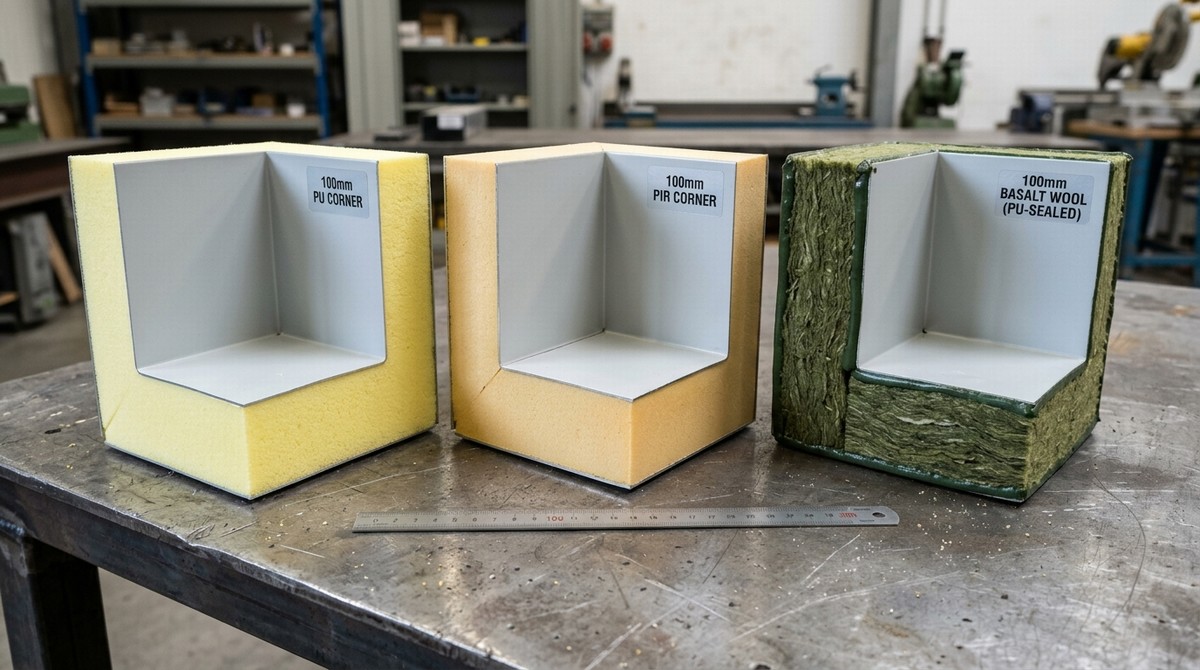
Why Global Insurers Prefer PIR Over Traditional PU Foam
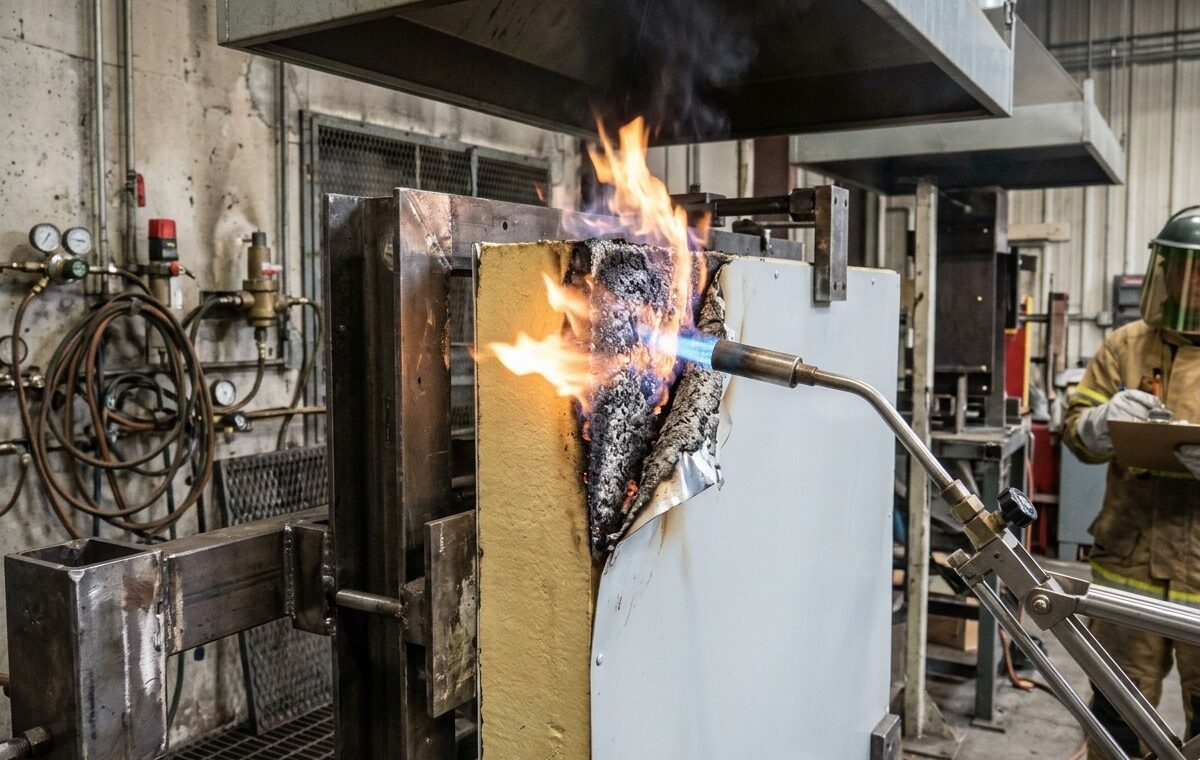
Look closely. PU and PIR look almost identical on a sample block. Hold a propane torch to both corners for thirty seconds and you will never confuse them again.
Standard polyurethane (PU) relies on a 1:1 ratio of polyol to isocyanate, which gives great cold insulation but softens and chars slowly in a high-heat fire. Polyisocyanurate (PIR) increases the isocyanate index above 250 with special trimerization catalysts. When fire hits a PIR panel, the foam immediately swells into a rigid black carbon crust that shields the inner core and stops flame spread, earning Class B1 (EN 13501 B-s1,d0) certification. Because PIR only costs $1.50 to $3.00 per square meter more than standard PU on our continuous foaming line, 80% of export buyers now specify PIR for commercial sandwich wall panels and refrigerated depots.
The Hybrid Solution: PU Edge-Sealed Rock Wool Panels
Water ruins open wool. Standard rock wool has one annoying weakness: open mineral fibers soak up rainwater if a roof flashing leaks, making the board heavy and weak at the tongue-and-groove joint.
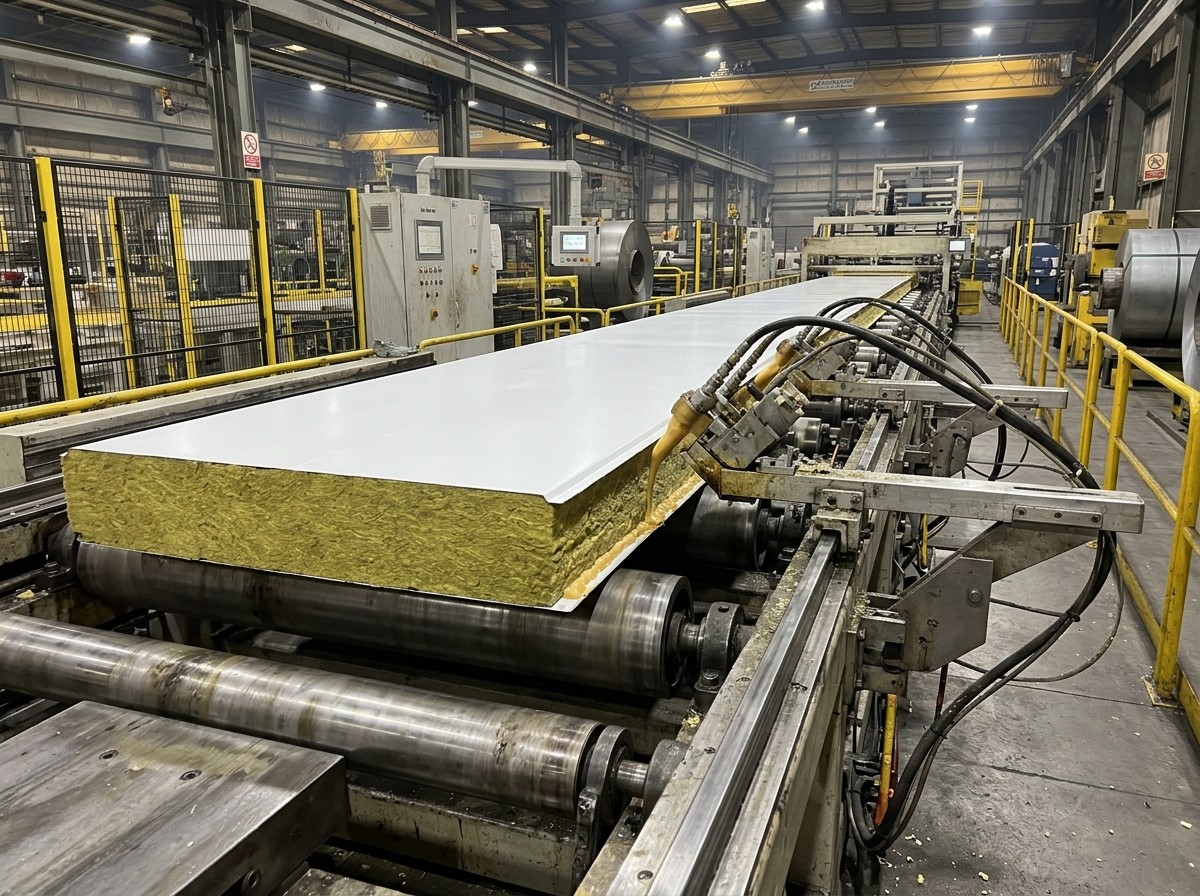
To get A1 fire safety without soggy edges, our automated continuous line pours a 35mm-wide strip of rigid polyurethane along both longitudinal edges of the rock wool core in a single pass. Those twin PU side seals stiffen the interlocking lip, lock moisture out of the basalt fibers, and make installation just as tight as a pure PIR board.
Frequently Asked Questions (FAQ)
Q1: Which sandwich panel has the best thermal insulation performance?
A: PIR and PU panels tie for the best thermal insulation with a lambda value of 0.021 to 0.024 W/m·K, nearly twice as efficient per millimeter as rock wool (0.040 W/m·K) or EPS (0.036 W/m·K).
Q2: Is PIR sandwich panel completely fireproof?
A: No. PIR is Class B1 flame-retardant and self-extinguishing (forms a protective char layer without flaming droplets), whereas only basalt rock wool is 100% inorganic Euroclass A1 non-combustible.
Q3: Why are rock wool sandwich panels heavier than PU/PIR panels?
A: Rock wool cores are manufactured at 100 to 140 kg/m³ density compared to 40 kg/m³ for PIR foam. A 100mm rock wool panel weighs roughly 21 kg/m² versus 13.5 kg/m² for PIR.
Q4: Can you mix rock wool walls with PIR roof panels on the same factory?
A: Yes! Many industrial projects use A1 rock wool panels along property-line firewalls and electrical rooms while installing lightweight, moisture-proof PIR sandwich panels on the main roof.
Q5: What is the typical factory wholesale MOQ for custom PIR or rock wool panels?
A: Standard factory MOQ is 300 to 500 square meters per thickness and color, or one full 40HQ container (600 to 1,100 sqm) to minimize per-square-meter ocean freight.