The Exact Formula Every Roll-Former Uses on the Shop Floor
Steel mills sell galvanized (GI) and prepainted (PPGI) coils by the metric ton, but roofing factories and cladding contractors sell finished sheets by the linear meter. If you miscalculate the conversion by 4%, your profit margin vanishes on the first container.
Carbon steel has a standard density of 7.85 grams per cubic centimeter, which equals 7.85 kilograms per square meter for every 1.0 millimeter of thickness ([Nika Steel GI Coil Calculator]). To find the exact linear meters in one metric ton (1,000 kg), divide 1,000 by the product of 7.85, the coil thickness in millimeters, and the coil width in meters: Meters per Ton = 1000 / (7.85 x Thickness_mm x Width_m). Take a standard 0.50mm thick, 1000mm (1.0m) wide coil used on continuous lines to press sandwich wall panels. Multiply 7.85 by 0.50 and by 1.0, giving 3.925 kilograms per linear meter. Divide 1,000 kilograms by 3.925, and you get 254.78 linear meters per metric ton. If that same 0.50mm coil is slit to 1200mm (1.2m) wide for corrugated roof profiling, each meter weighs 4.71 kilograms, yielding 212.31 meters per ton.
| Total Thickness (mm) | Weight/m (1000mm Wide) | Meters/Ton (1000mm Wide) | Weight/m (1200mm Wide) | Meters/Ton (1200mm Wide) |
| 0.30 mm | 2.355 kg/m | 424.6 meters | 2.826 kg/m | 353.8 meters |
| 0.35 mm | 2.748 kg/m | 363.9 meters | 3.297 kg/m | 303.3 meters |
| 0.40 mm | 3.140 kg/m | 318.5 meters | 3.768 kg/m | 265.4 meters |
| 0.45 mm | 3.533 kg/m | 283.1 meters | 4.239 kg/m | 235.9 meters |
| 0.50 mm | 3.925 kg/m | 254.8 meters | 4.710 kg/m | 212.3 meters |
| 0.60 mm | 4.710 kg/m | 212.3 meters | 5.652 kg/m | 176.9 meters |
| 0.80 mm | 6.280 kg/m | 159.2 meters | 7.536 kg/m | 132.7 meters |
| 1.00 mm | 7.850 kg/m | 127.4 meters | 9.420 kg/m | 106.2 meters |
How Negative Thickness Tolerance Changes Your Actual Yield
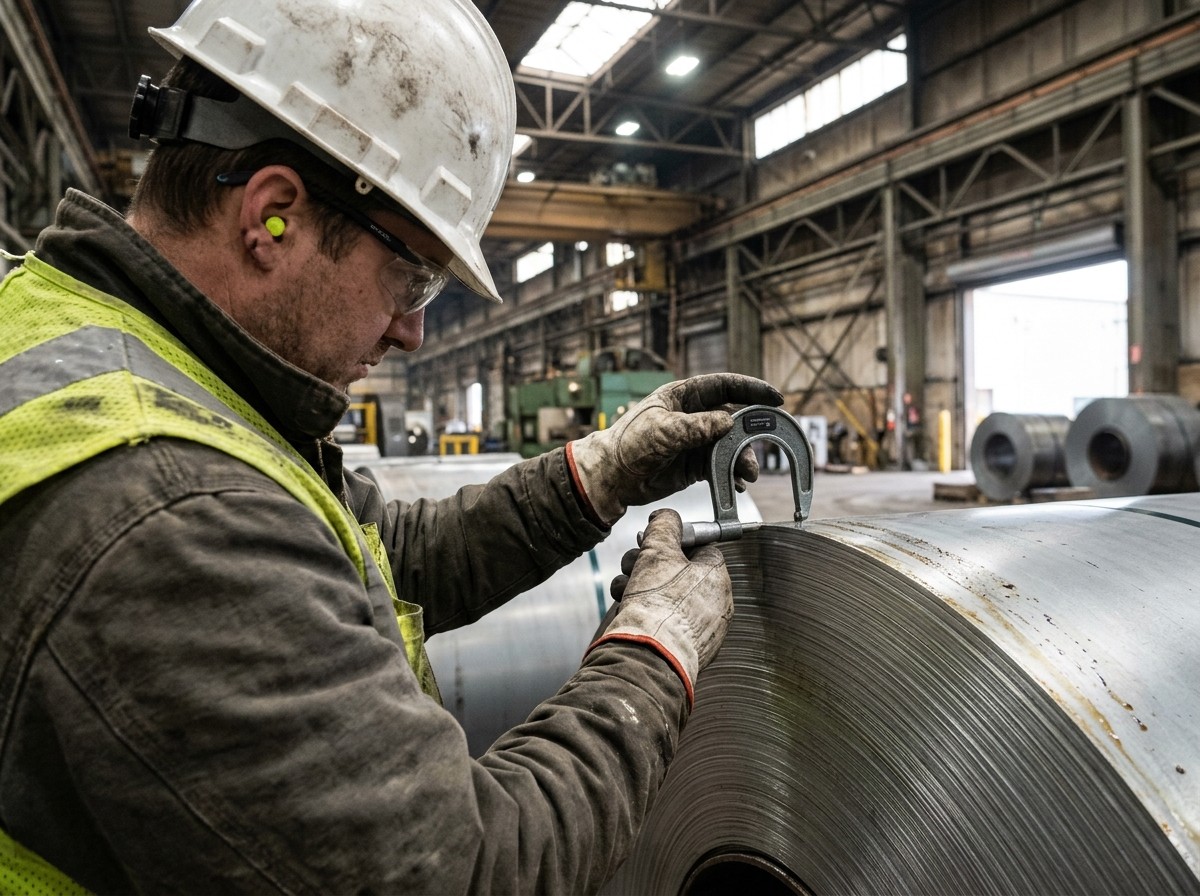
Why did your decoiler counter read 242 meters per ton on a batch of 0.50mm coil from one trader and 268 meters per ton from another? Because one mill rolled positive tolerance and the other rolled deep negative tolerance.
In international coil contracts, buyers sometimes order ‘0.50mm nominal’ with a wide plus or minus 0.04mm tolerance. If a supplier ships 0.53mm steel to inflate tonnage weight on a scale-weight contract, you only get 240.3 meters per ton in 1000mm width, leaving your roll-forming line short by 14 meters on every ton when cutting fixed-length roof sheets. Conversely, if a trader ships 0.46mm thin steel disguised as 0.50mm, the coil runs longer (276.6 meters per ton), but your finished sandwich roof panels fail purlin wind-load tests. On our slitting lines in Boxing, Shandong, we lock thickness tolerance within plus or minus 0.015mm using closed-loop X-ray thickness gauges so your linear meter yield matches your purchasing spreadsheet within 1%.
Do Heavy Z275 Zinc Layers or AZ150 Coatings Change the Meter Count?
Buyers often ask whether switching from Z60 (60 g/m² zinc) to heavy structural Z275 (275 g/m² zinc) or from GI to Galvalume (AZ150) alters the meters-per-ton table.
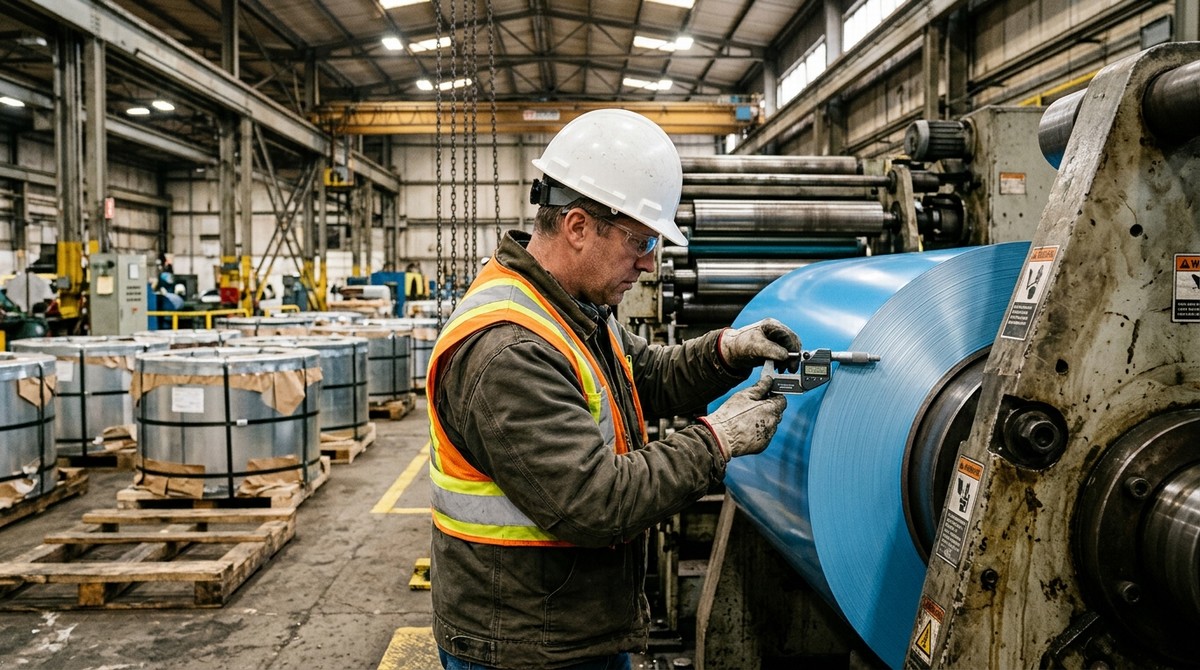
It depends on whether your purchase order specifies Total Coated Thickness (TCT) or Base Metal Thickness (BMT). Zinc has a density of 7.14 g/cm³, which is slightly lighter than steel (7.85 g/cm³), while 55% Al-Zn Galvalume alloy has a much lower density of 3.75 g/cm³. A Z275 zinc coating adds roughly 0.038mm to the steel core, and a 25/7 micron PPGI paint system adds another 0.032mm. If you order 0.50mm TCT, the total thickness including zinc and paint is 0.50mm, so the standard 7.85 formula gives a rock-solid commercial estimate within 0.5%. However, if an Australian or European project specifies 0.50mm BMT plus Z275 zinc plus PVDF paint, the actual total thickness on the micrometer is 0.57mm, adding about 302 grams per square meter to the coil weight and reducing your linear meters per ton by roughly 7%. Check our technical installation guides for full BMT-to-TCT conversion tables.
Frequently Asked Questions (FAQ)
Q1: How many meters are in 1 ton of 0.45mm x 1200mm PPGI steel coil?
A: Using the formula 1000 / (7.85 x 0.45 x 1.2), one metric ton of 0.45mm x 1200mm PPGI coil contains approximately 235.9 linear meters.
Q2: How many square meters are in 1 ton of 0.50mm galvanized steel sheet?
A: Regardless of coil width, 1 metric ton of 0.50mm steel contains 1000 / (7.85 x 0.50) = 254.78 square meters of flat sheet.
Q3: What is the standard weight of a single export GI or PPGI steel coil?
A: Standard export seaworthy coils weigh between 3.5 and 5.5 metric tons each, allowing 5 to 7 coils (25 to 28 metric tons total) to be loaded safely onto wooden pallets inside a 20GP container.
Q4: Why is Galvalume (GL/PPGL) coil slightly longer per ton than GI coil at the same BMT?
A: Because the 55% aluminum-zinc coating on Galvalume has a density of 3.75 g/cm³ compared to 7.14 g/cm³ for pure zinc, so the protective metallic layer weighs nearly half as much for the same coating thickness.
Q5: How much scrap length is lost at the inner and outer laps of a steel coil?
A: Roll-forming factories typically budget 1.5 to 3 meters of head-and-tail threading loss per coil for decoiler feeding and inner core jaw marks.