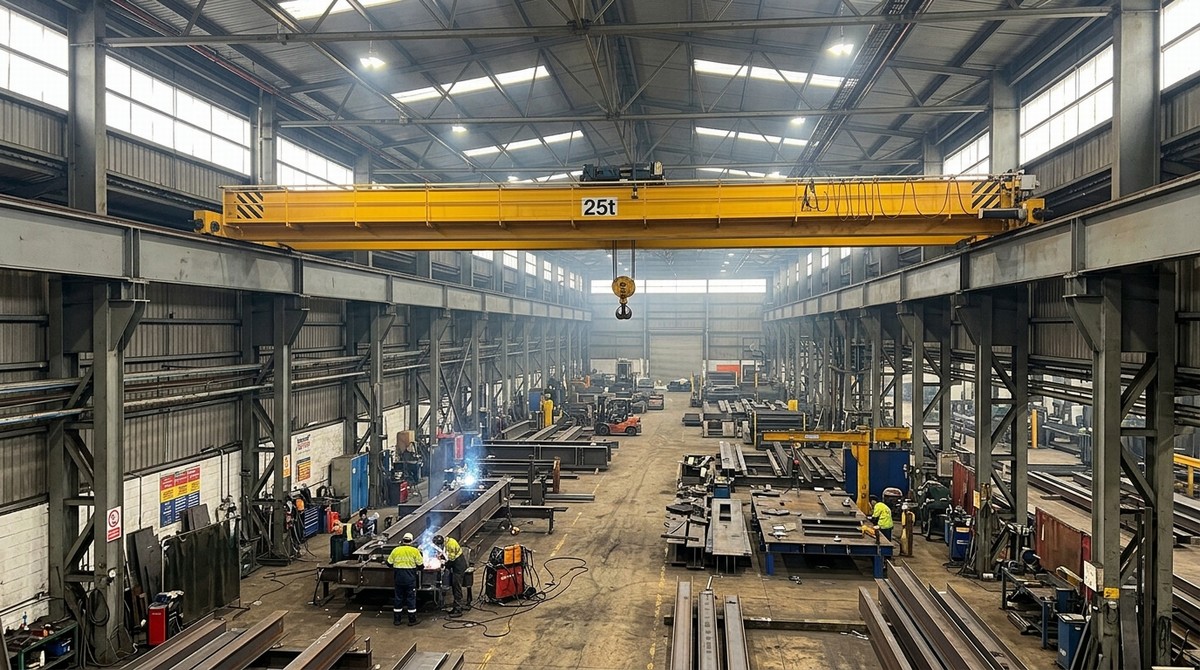
How Do You Design a Steel Structure Workshop for an Overhead Bridge Crane? Why You Cannot Bolt an Overhead Crane Onto a Standard Warehouse Frame Factory buyers frequently ask if they can hang a 10-ton bridge crane inside an existing storage shed. Do that without reinforcing the columns and the crane wheels will jam on the rails during the first heavy lift. An overhead crane does not just push straight down. When a 20-ton crane hoists a steel coil, rolls down the 100-meter bay at 40 meters per minute, and slams on the brakes while the trolley jerks sideways, it hammers the building frame with three simultaneous forces: vertical wheel loads, longitudinal braking thrust along the rails, and lateral trolley surge perpendicular to the walls. If your columns flex outward by more than 15 millimeters under lateral surge, the crane span binds against the QU80 or P24 rail gauge and derails. When designing heavy manufacturing shops, we ask for six numbers on day one: crane lifting capacity, ISO duty class (A3 to A7), hook lift height, crane span, maximum wheel load, and how many cranes run on the same track.
| Crane Capacity & Duty | Column Support Type | Runway Beam Deflection Limit | Recommended Tie & Bracing | Typical Workshop Use |
|---|---|---|---|---|
| 3T – 10T (A3-A4 Light/Med) | Welded H-Beam + Corbel Bracket | L / 600 (Vertical) | Round bar or angle rod X-bracing | Machining shops, mold assembly, warehouses |
| 15T – 32T (A5 Medium-Heavy) | Heavy H-Beam or Stepped Column | L / 800 (Vertical) | Double-tier angle/channel portal bracing | Steel coil slitting, heavy equipment fabrication |
| 50T – 100T+ (A6-A7 Heavy) | Laced / Box Stepped Column + Brake Truss | L / 1000 (Vertical) | Full welded tube truss + horizontal brake girder | Metallurgical foundries, turbine assembly halls |
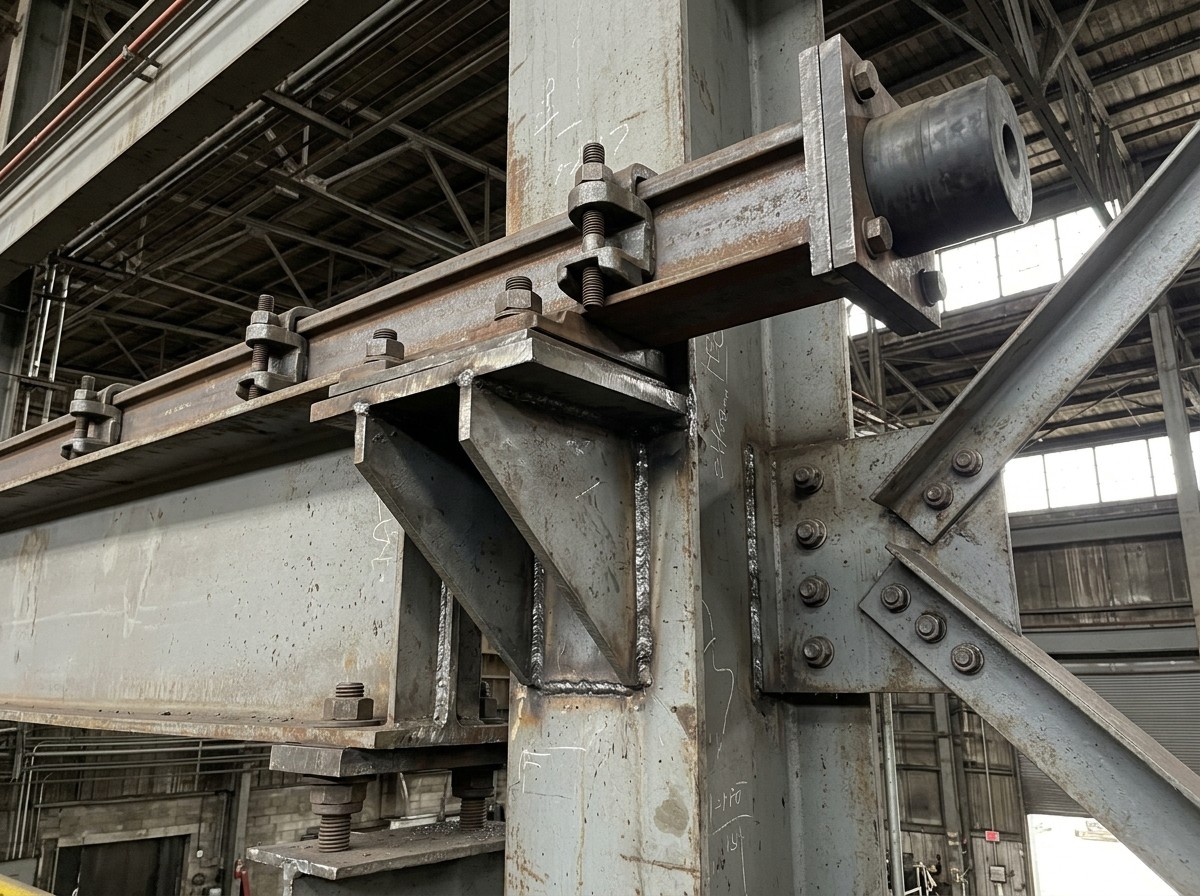
Corbel Brackets vs Stepped Columns: The 20-Ton Dividing Line
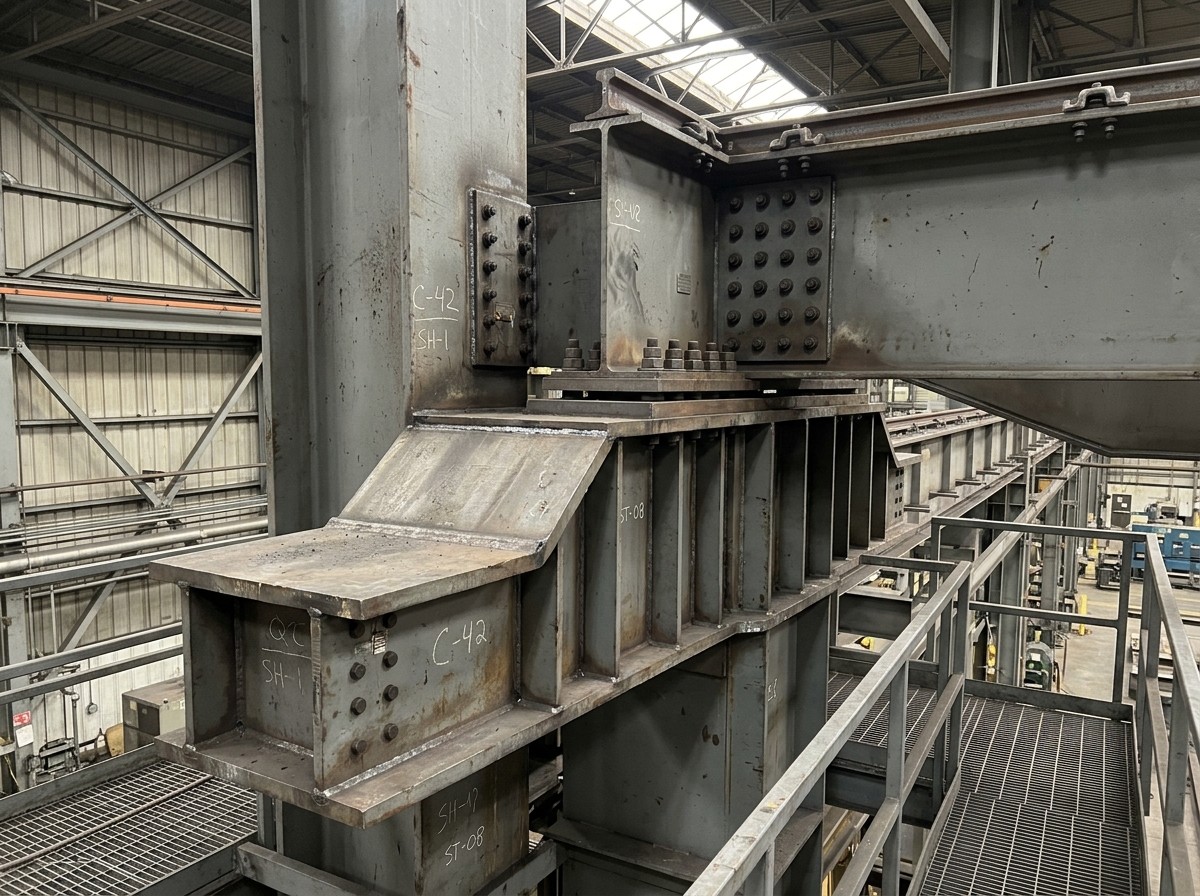
Up to 15 or 20 metric tons, a single-web welded H-beam column with a stiffened steel corbel bracket handles crane wheel loads cleanly. Our shop welds full-penetration stiffener plates directly behind the corbel flange on our welded H-beam columns and verifies every weld seam with ultrasonic testing (UT) so dynamic fatigue never cracks the bracket throat. Once crane capacity reaches 25 to 50+ tons, or when a workshop runs a lower 10-ton crane underneath an upper 50-ton gantry, a cantilevered corbel puts too much eccentric bending moment into the column shaft. Above 20 tons, we transition to a stepped column (shoulder column) where the crane runway beam sits directly on top of a dedicated inner column leg while the outer leg rises to carry the roof rafter. Runway Beam Deflection Limits and Two-Tier Column Bracing Roof rafters can flex L/180 under snow without anyone noticing. Crane runway girders cannot. If a 6-meter crane runway beam sags more than L/600 (10mm) under a 10-ton crane or L/800 (7.5mm) under a 25-ton crane, the crane bridge has to climb an uphill slope at every column line, burning out travel motors and chewing up wheel flanges. We fabricate crane beams with widened upper flanges or horizontal surge plates, connect them with fatigue-resistant high strength bolts, and install rigid angle-steel two-tier column bracing both above and below the crane corbel elevation to dump longitudinal braking forces straight into the foundation.
Frequently Asked Questions (FAQ)
Q1: How do you calculate the required building eave height for an overhead crane workshop?
A: Add the required clear hook height + the crane hoist and bridge depth (typically 1.2m to 2.2m) + the crane runway beam depth (0.5m to 0.9m) + a 300mm to 500mm safety clearance below the roof rafter knee.
Q2: What is the difference between a single-girder and double-girder crane for steel building design?
A: Single-girder cranes (typically 1 to 16 tons) hang the hoist below the main beam, requiring less headroom and lighter corbels. Double-girder cranes (16 to 100+ tons) run the trolley on top of two box girders, giving higher hook lift but imposing heavier wheel loads.
Q3: Can two overhead cranes run on the same runway beam in a steel building?
A: Yes, provided the runway beam and columns are engineered for simultaneous adjacent wheel loads with hydraulic or rubber end buffers installed between the two crane bridges.
Q4: Why do crane workshops use rigid angle or tube bracing instead of wire rope cables?
A: Flexible wire rope cables stretch under repeated longitudinal crane braking impacts. Rigid double-angle or steel pipe struts below the crane beam level prevent longitudinal frame sway.
Q5: Can you add a 5-ton crane to a steel building that was not designed for one?
A: Instead of overloading existing light roof columns, the safest retrofit is installing an independent floor-mounted freestanding crane runway column system with its own concrete pad footings inside the existing building.