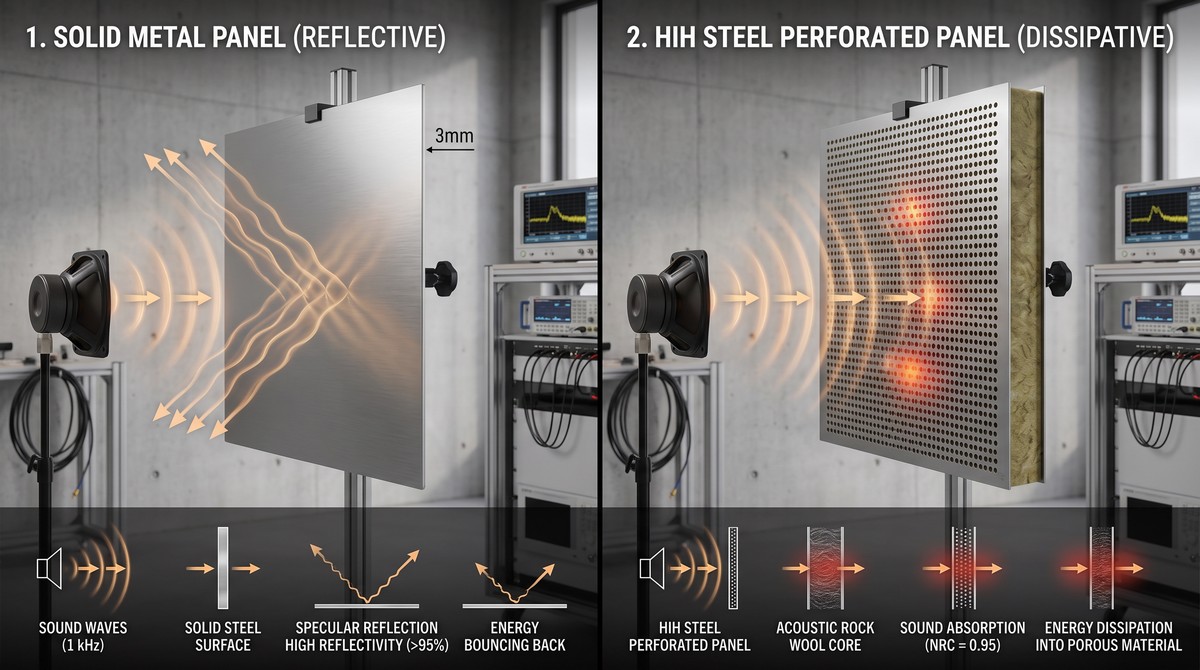
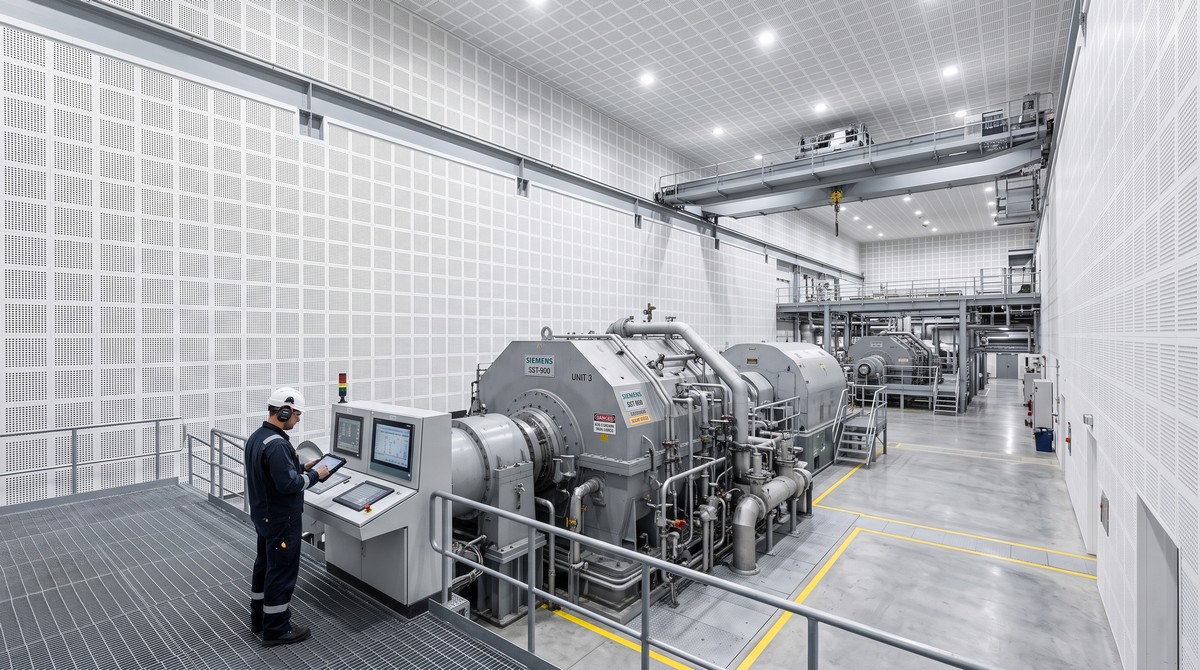
In heavy manufacturing plants, power generating stations, gas turbine enclosures, and stamping press halls, interior ambient noise levels frequently exceed 95 dBA to 110 dBA. Prolonged exposure to extreme sound pressure levels triggers irreversible employee hearing loss, increases workplace accidents, and invites severe penalties under occupational safety regulations like OSHA 1910.95 and EU Directive 2003/10/EC (mandating an 85 dBA 8-hour exposure ceiling). Ordinary solid metal cladding merely reflects sound waves, creating a deafening reverberation chamber within enclosed steel structures.
As structural acoustics engineers at hihsteel explain, mitigating high-energy sound requires a dual acoustic mechanism: sound absorption (reducing reverberation reflections inside the room) and sound transmission loss (preventing noise breakout through external partitions). Perforated rock wool sandwich panels provide the optimal hybrid acoustic solution by merging a tuned Helmholtz resonator face with a high-density porous dissipative fibrous core.
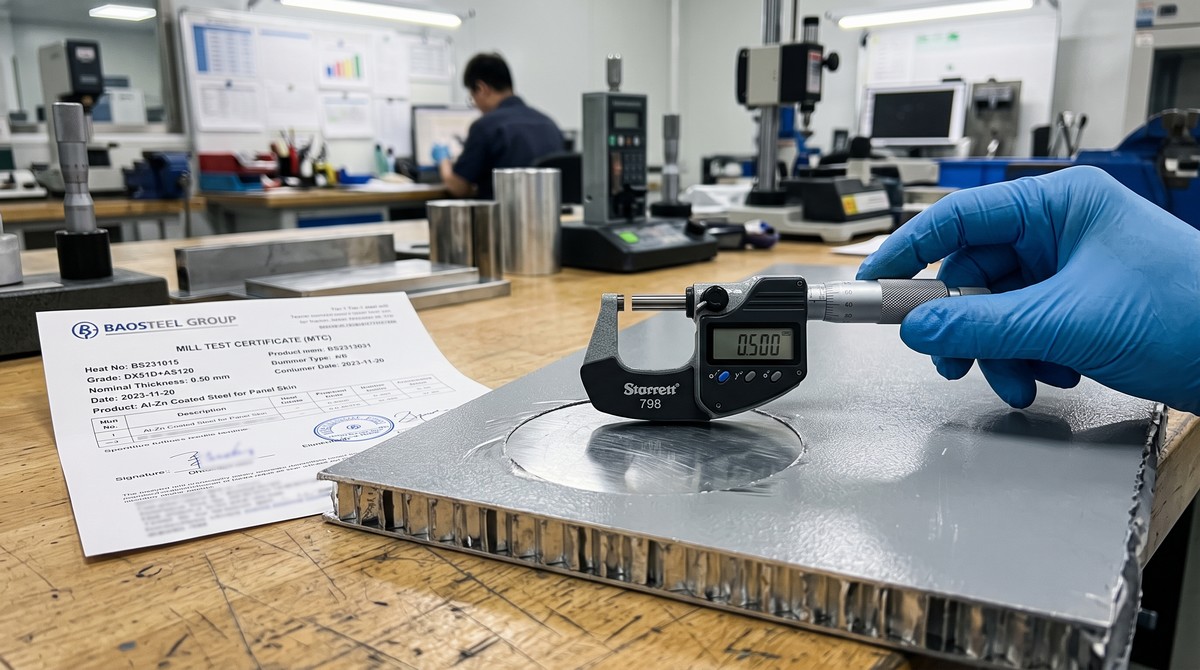
The architectural anatomy of an HIH Steel perforated acoustic panel is engineered with micro-precision. The interior steel facing undergoes high-speed CNC punching, introducing a uniform staggered perforation pattern (typically 3.0mm to 4.0mm diameter holes yielding an open area ratio of 23% to 28%). Directly behind the perforated metal skin, a specialized flame-retardant non-woven glass fiber acoustic scrim (black sound tissue) is thermo-laminated. This membrane serves two critical functions: it prevents microscopic rock wool dust fibers from escaping into the ambient workspace while creating viscous boundary-layer air resistance that dampens sound waves.
As acoustic pressure waves strike the perforated face, air molecules oscillate rapidly through the perforations. Upon entering the labyrinth of the 120 kg/m³ vertically oriented rock wool core, sound kinetic energy is transformed into negligible thermal energy via viscous friction and fiber vibration. Certified laboratory testing under ISO 354 and ASTM C423 confirms an extraordinary Noise Reduction Coefficient of NRC ≥ 0.88 to 0.92, while delivering a sound transmission loss rating of STC ≥ 35 dB to 40 dB under ASTM E90.
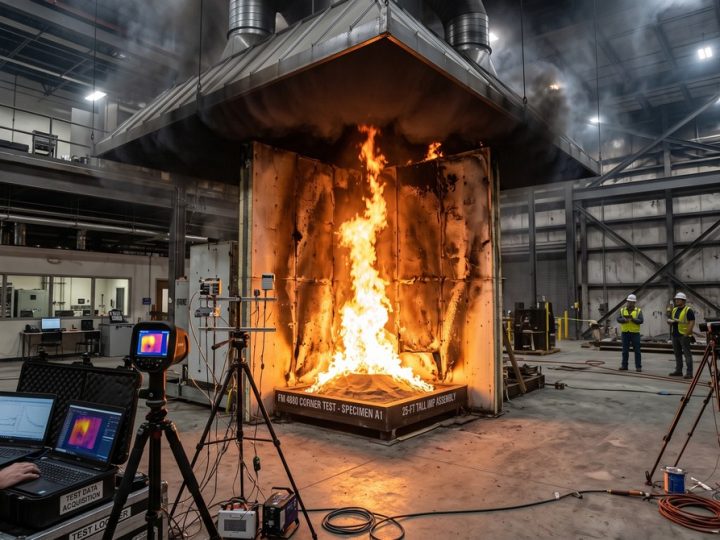
Beyond industrial engine rooms, HIH Steel perforated panels are widely specified for high-speed rail noise barriers, airport maintenance hangars, indoor sports arenas, and recording studios. The panels preserve Class A1 non-combustible fire safety while offering customizable aesthetic finishes in over 200 RAL colors. Transform your high-noise facility into an acoustically compliant work environment by visiting hihsteel.com.
Acoustic Attenuation Performance: HIH Steel Perforated Panels vs. Standard Solid Cladding
| Acoustic Parameter | HIH Steel Perforated Rock Wool Panel | Standard Solid Sandwich Panel | Industrial Safety Benefit |
| Noise Reduction Coefficient (NRC) | 0.85 – 0.92 (Extreme Absorption) | 0.10 – 0.15 (Highly Reflective) | Absorbs up to 90% of reflected acoustic energy, killing echo |
| Sound Transmission Class (STC) | 35 dB – 42 dB (High Isolation) | 28 dB – 32 dB (Moderate Isolation) | Prevents loud machinery noise from breaking out to adjacent zones |
| Perforation Pattern | CNC staggered 3mm holes, 25% open ratio | Solid non-perforated facing | Precisely tuned for mid-to-high frequency industrial machinery dampening |
| Acoustic Tissue Layer | Flame-retardant non-woven glass scrim | None | 100% dust encapsulation; prevents mineral fiber inhalation |
| Fire Safety Classification | Class A1 Non-combustible (EN 13501-1) | Class A1 Non-combustible | Maintains certified 2 to 4-hour fire barrier integrity |
| OSHA & EU Noise Compliance | Enables workplace noise < 85 dBA compliance | Amplifies echoes, increasing dBA levels | Eliminates hearing loss liability and OSHA occupational fines |