Article Body & Engineering Specifications
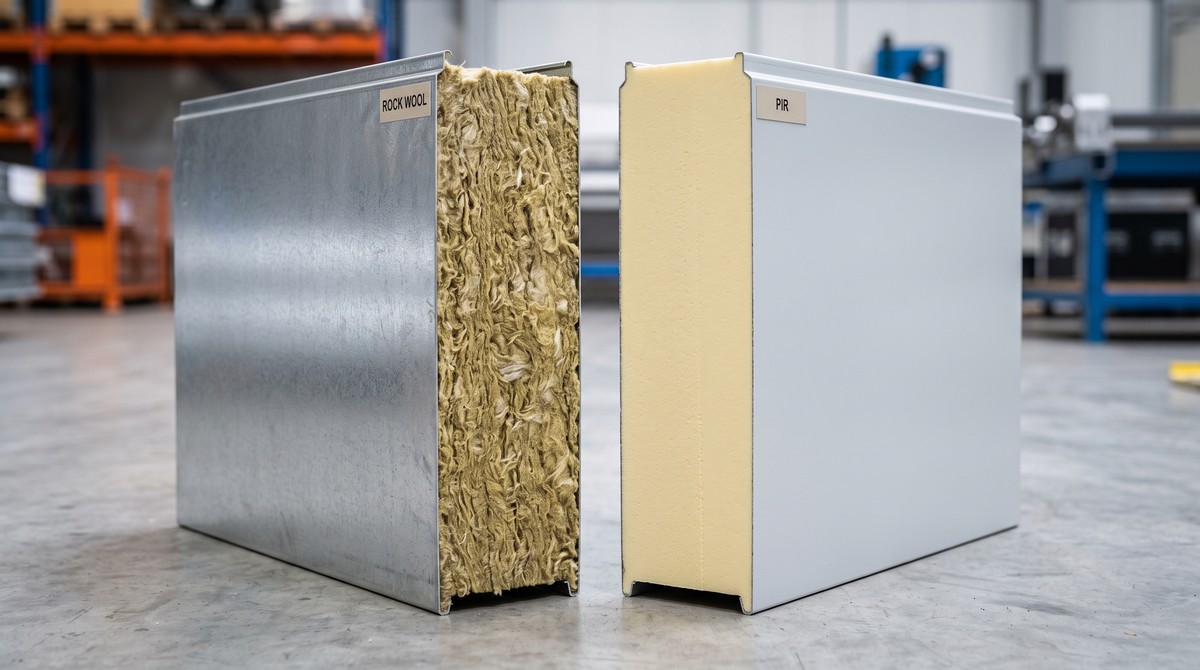
When designing modern industrial warehouses, commercial facilities, or logistics hubs, structural engineers and procurement managers face a critical crossroad: Rock Wool or PIR (Polyisocyanurate) sandwich panels? Making the wrong selection doesn’t just mean inflated energy bills—it could lead to catastrophic structural failure during a fire emergency. At HIHSteel as an international OEM sandwich panel manufacturer, we break down the hard physics, performance metrics, and cost formulas to help you decide with 100% confidence.
1. Fire Performance: Non-Combustible Rock Wool Takes the Crown
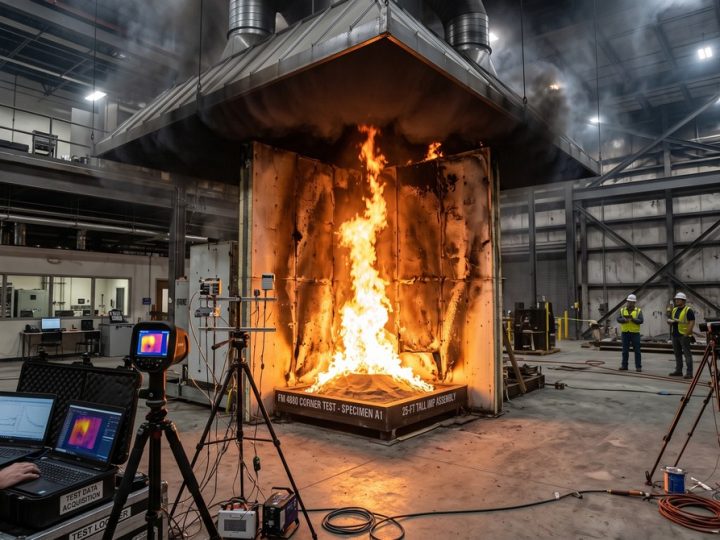
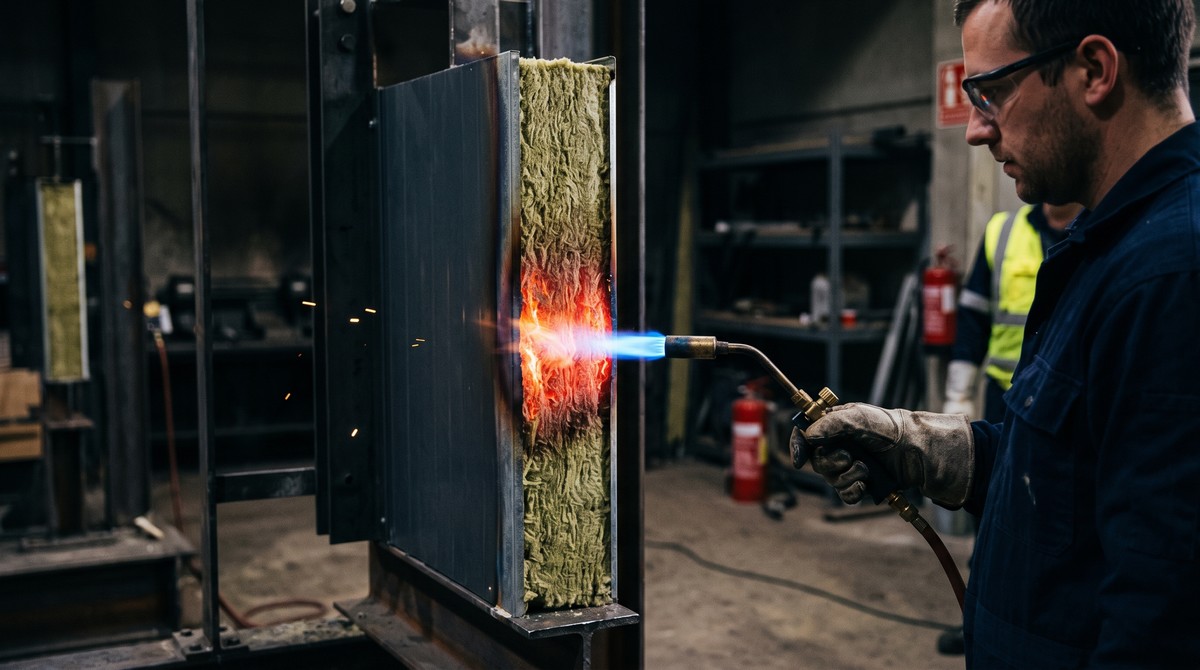
If your facility handles flammable chemicals, high-density warehousing, or strictly requires insurance compliance under FM Global 4880 (https://www.fmglobal.com) and ASTM E84 Class A (https://www.astm.org), Rock Wool is the undisputed king. Made from melted volcanic basalt stone spun into microscopic mineral fibers, Rock Wool delivers a melting point exceeding 1,000°C. Under EN 13501-1 fire classifications, Rock Wool achieves Euroclass A1/A2, releasing zero toxic smoke and zero burning droplets. In contrast, premium PIR panels formulated with high isocyanate index (PIR index > 250) reach B-s1, d0 (or Class B1 flame retardant), resisting direct flames by forming an active surface carbonization layer, but cannot match the absolute zero-flammability of mineral rock wool.
2. Thermal Conductivity (Lambda λ): PIR Slashes Energy Costs by 45%
Where thermal barrier and HVAC operating expenditure are the top priorities, PIR utterly outclasses rock wool. With an ultra-low thermal conductivity of λ ≤ 0.022 W/(m·K), a 100mm PIR panel delivers the equivalent thermal resistance (R-value) of an 180mm rock wool panel (λ ≈ 0.040 W/(m·K)). This significant difference allows architects to use thinner walls, maximize usable indoor floor space, and drastically reduce structural dead loads on the steel framing.
| Technical Parameter | Rock Wool Sandwich Panel | PIR Sandwich Panel | Winner / Best Application |
| Core Density | 80 – 140 kg/m³ | 38 – 42 kg/m³ | Rock wool for structural ballast; PIR for light weight |
| Thermal Conductivity (λ) | 0.038 – 0.045 W/(m·K) | 0.019 – 0.022 W/(m·K) | PIR (Over 45% superior thermal insulation) |
| Fire Classification | Class A1 / A2 (Non-combustible) | Class B1 (Flame retardant, self-extinguishing) | Rock Wool (Impervious to 1000°C heat) |
| Acoustic Absorption (NRC) | 0.75 – 0.85 (Sound isolating) | 0.15 – 0.25 (Acoustically reflective) | Rock Wool (Superior sound dampening) |
| Water Absorption Rate | Hydrophobic treated ≥ 98% | Closed-cell rate ≥ 95% (Impermeable) | PIR (Zero moisture retention) |
3. The Hybrid Breakthrough: Polyurethane Edge-Sealed Rock Wool Panels
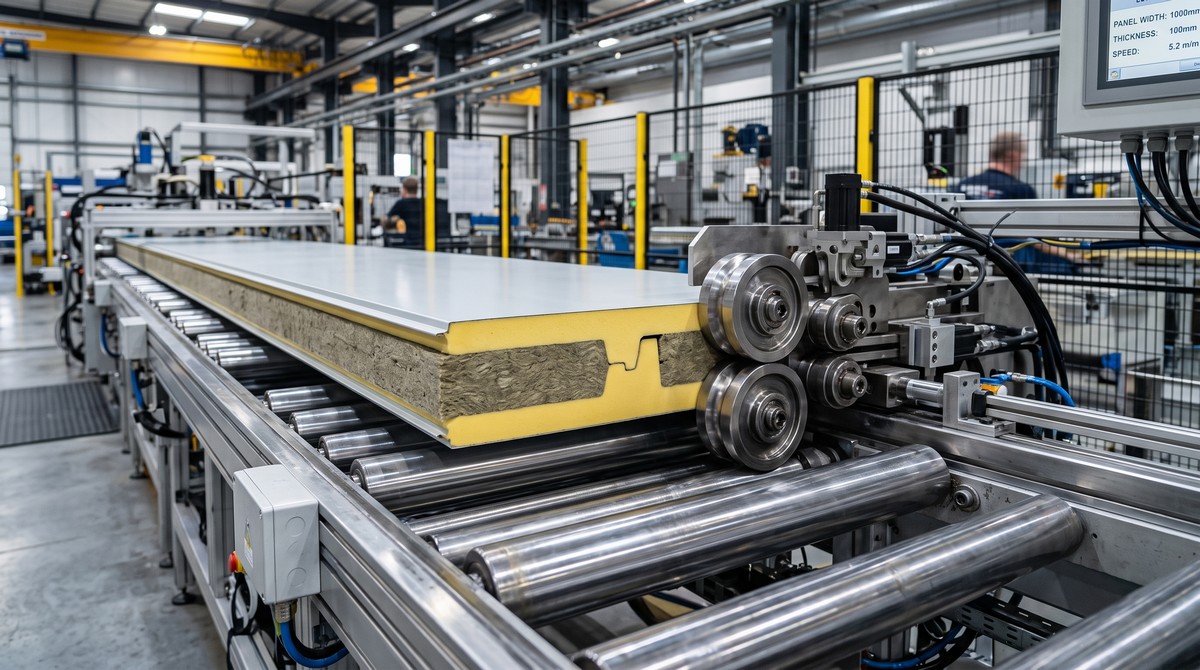
Why compromise between fire safety and water resistance? At HIH Steel (https://www.hihsteel.com), our cutting-edge continuous double-belt production line manufactures PU Side-Sealed Rock Wool Sandwich Panels. By casting rigid polyurethane foam along the tongue-and-groove joints while locking dense basalt rock wool in the center, we completely eliminate rock wool’s natural moisture vulnerability, boost joint tensile strength by 35%, and ensure airtight tongue-and-groove locking. Contact our engineering team today for customized OEM factory quotes and project span load calculations!