
Total Two-Side Weight vs Single-Side Thickness: Clearing Up the Math
A lot of importers assume ‘Z275’ means 275 grams of zinc on every square meter of the top surface. Wrong. Under European EN 10346, the number after ‘Z’ is always the combined minimum zinc mass across BOTH sides of the steel sheet.
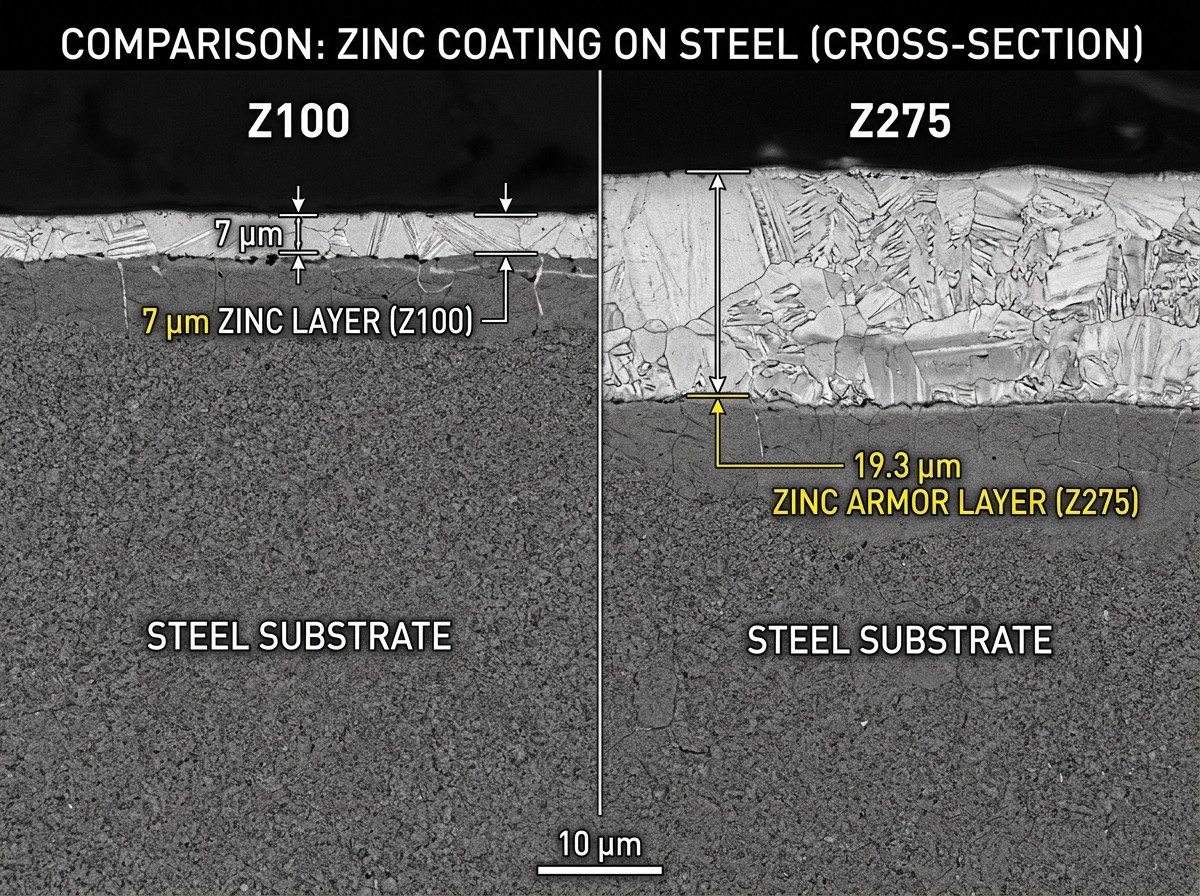
Take a standard Z275 galvanized steel coil. Divide 275 grams per square meter by two surfaces, and each side carries roughly 137.5 g/m² of pure zinc. Since zinc has a density of 7.14 g/cm³, dividing 137.5 by 7.14 gives an average coating thickness of 19.3 microns per side. By contrast, a light Z100 coil carries only 50 g/m² (7.0 microns) per side, nearly one-third as much sacrificial armor. If you buy under American ASTM A653 standards, G90 (0.90 oz/ft² total) equals Z275, G60 equals Z180, and G40 equals Z120.
| EN 10346 Class | ASTM A653 Equivalent | Total Zinc (Both Sides) | Approx. Microns per Side | Recommended B2B Use |
|---|---|---|---|---|
| Z60 – Z80 | G20 – G30 | 60 – 80 g/sqm | 4.2 – 5.6 um | Dry indoor furniture tubes, drywall studs |
| Z100 – Z120 | G35 – G40 | 100 – 120 g/sqm | 7.0 – 8.4 um | Indoor HVAC ducts, economy PPGI base |
| Z180 | G60 | 180 g/sqm | 12.6 um | Inland warehouse cladding, light purlins |
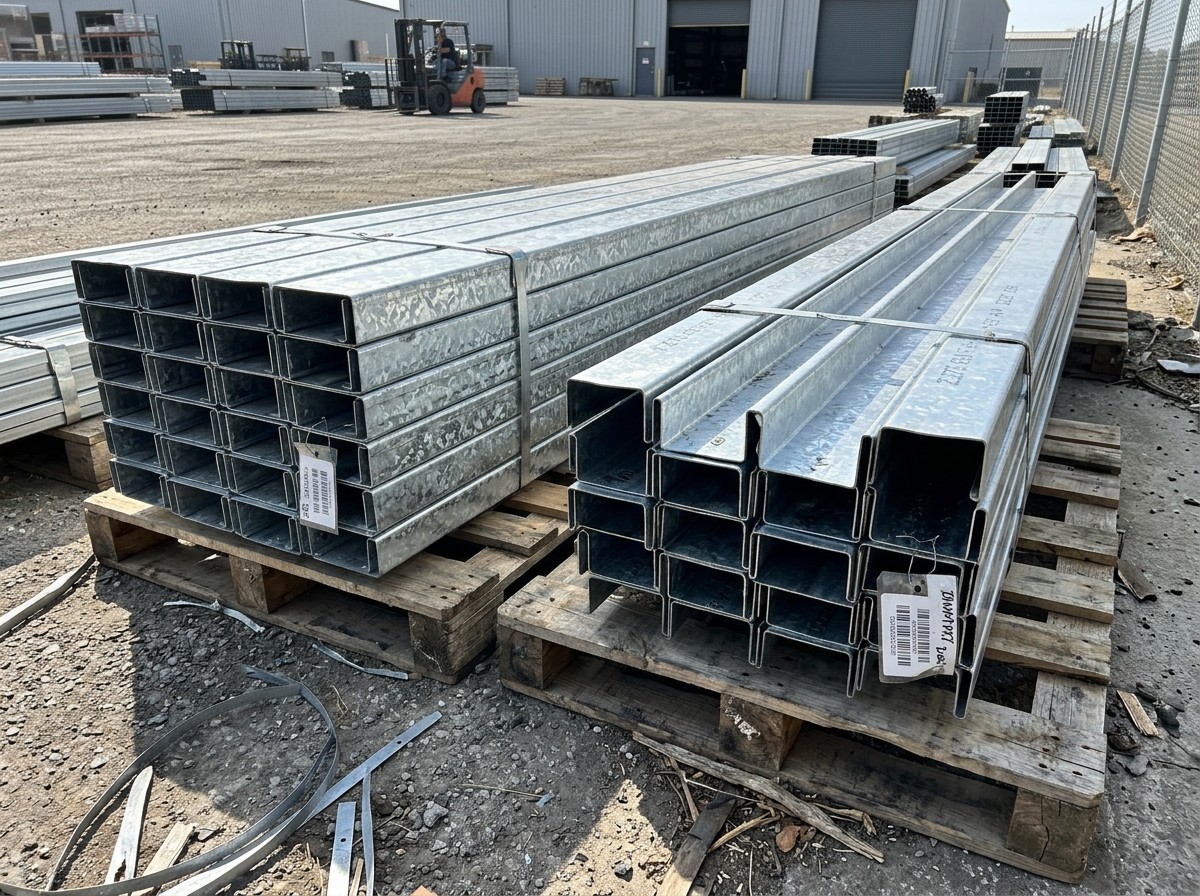
| Z275 | G90 | 275 g/sqm | 19.3 um | Structural C/Z purlins, floor decks, outdoor roofs |
Why Paying $35 More per Ton for Z275 Triples Outdoor Rust Resistance
Zinc corrodes linearly over time as it sacrifices itself to protect bare steel. Double the zinc thickness and you literally double the years before red rust appears.
In a typical urban or light industrial atmosphere where zinc erodes at roughly 1.0 to 1.5 microns per year, an unpainted Z100 sheet (7 microns per side) hits bare steel in five to seven years. Step up to Z275 (19.3 microns per side) on structural galvanized C and Z purlins or composite floor decks, and the zinc layer protects the steel for 15 to 20+ years before red rust starts, yet upgrading from Z100 to Z275 only adds roughly $30 to $45 per metric ton to your mill order.
Catching Fake Z275 Claims With Triple-Spot XRF Testing
Because pure zinc ingots cost over $2,800 per ton, dishonest traders love invoicing Z120 or Z140 coils as ‘Z275’ because the naked eye cannot tell a 9-micron zinc layer from a 19-micron zinc layer.
Every galvanized coil produced on our hot-dip lines passes an online X-ray fluorescence (XRF) coating gauge that plots left, center, and right zinc weights across the full coil length. Before shipping, our quality assurance team attaches the triple-spot acid strip test and XRF printout to your Mill Test Certificate so customs and structural inspectors sign off without delay.
Frequently Asked Questions (FAQ)
Q1: Is Z275 the same as ASTM G90 galvanized steel?
A: Yes. Z275 (275 g/m² total both sides under EN 10346) is the direct metric equivalent of ASTM A653 G90 (0.90 oz/ft² total both sides).
Q2: How many microns thick is Z275 vs Z100 zinc coating per side?
A: Z275 averages 19.3 microns per side (38.5 microns total both sides), while Z100 averages 7.0 microns per side (14.0 microns total both sides).
Q3: Can I use Z100 or Z80 galvanized steel for outdoor roof purlins?
A: No. Z80 and Z100 are strictly for dry indoor drywall studs, furniture tubes, or indoor ductwork. Outdoor structural roof purlins, solar mounting channels, and floor decks require Z275 (G90) minimum.
Q4: What zinc coating weight is recommended under PPGI color-coated paint?
A: For economical inland sheds, Z80 to Z120 under PE paint is common. For commercial 20-to-30-year industrial roofs and sandwich panels, specify Z180 to Z275 (or AZ150 Galvalume) under HDP or PVDF paint.
Q5: How can I check the actual zinc coating weight of a GI coil upon arrival?
A: Use a calibrated digital magnetic coating thickness gauge (remembering that 1 micron = 7.14 g/m² per side, so Z275 should read ~19 microns on each face) or send a 100x100mm coupon for an ASTM A90 acid weigh-strip-weigh lab test.