Cooling a warehouse is expensive. Really expensive. If your walls let summer heat sneak in through bad seams, the compressors run all day and night without stopping, and after just eighteen months those extra electric bills can cost more than what you paid for the panels on day one.
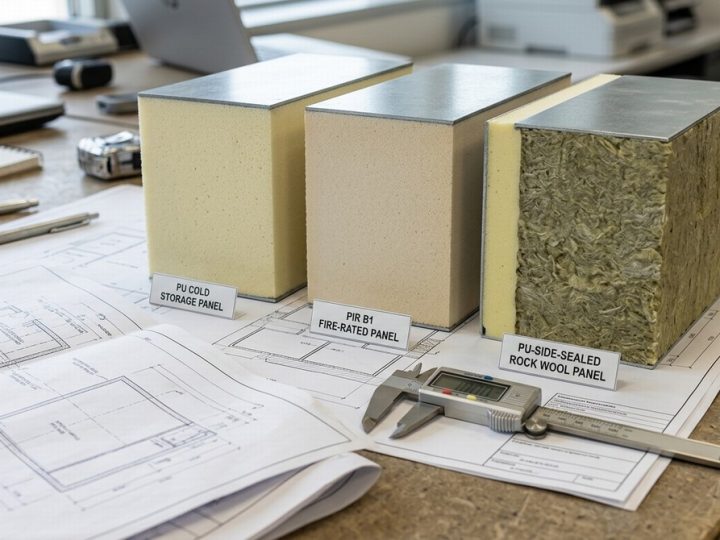
A good cold room panel is built differently from a normal shed board. At Hihsteel, we make cold room panels by injecting liquid polyurethane (PU) or polyisocyanurate (PIR) between two strong metal sheets under high pressure. Inside the mold or on the double-crawler track, the liquid reacts, expands fast, and sticks tightly to both steel faces. Because over 95% of the tiny foam bubbles stay closed, heat and wet air cannot pass through the board.
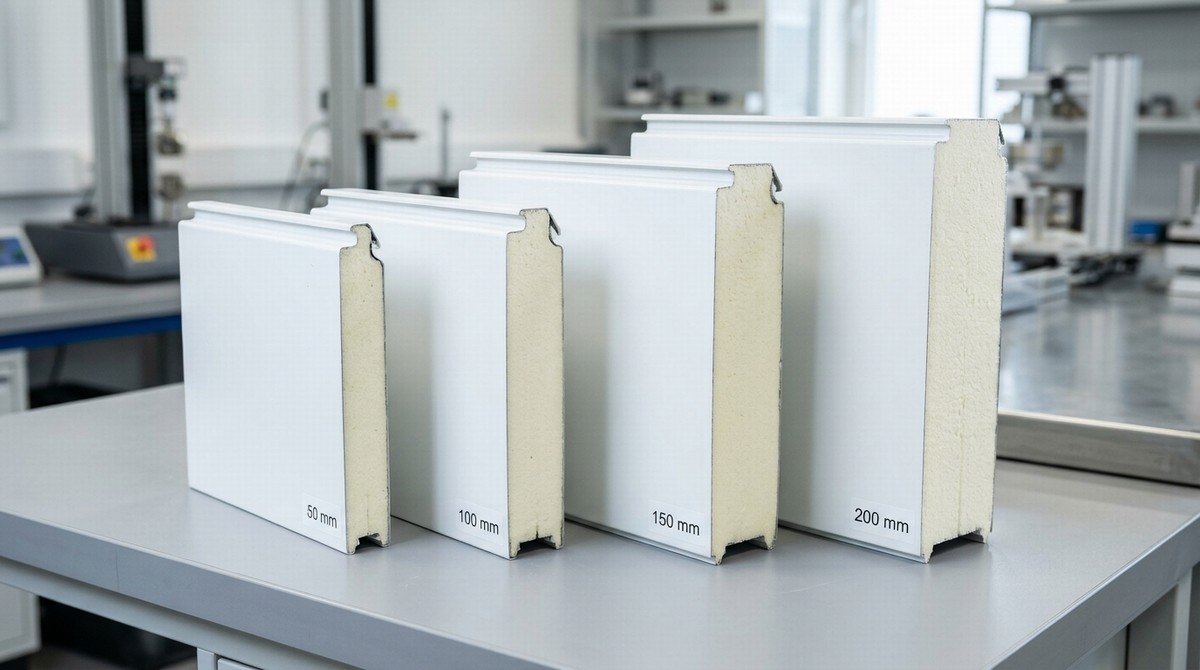
Buyers can pick different thicknesses from 50mm all the way up to 200mm to match what they store inside. If you are keeping fruits, vegetables, or flowers fresh at +5°C, a 75mm or 100mm panel is enough. If you store frozen meat or ice cream at -20°C, you need 150mm panels. For deep-freeze rooms below -30°C, 200mm boards keep the outside wall from sweating water. For dry sorting halls outside the cold box, many customers also order economical EPS wall panels or fire-safe rock wool boards to keep the total project price down.
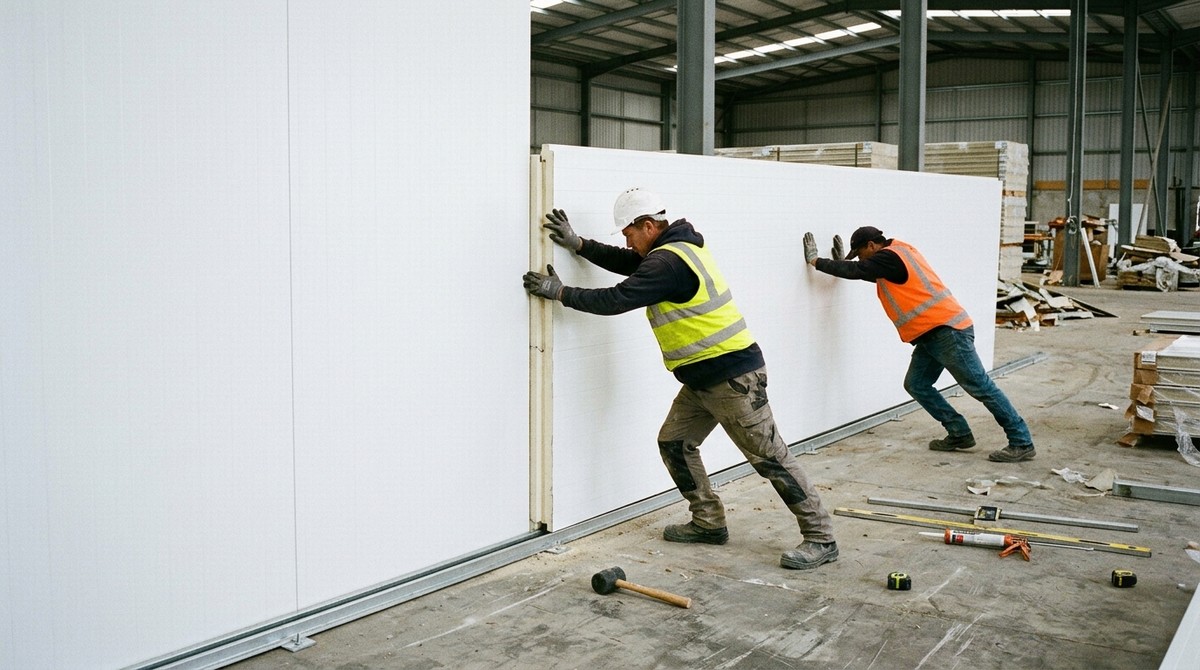
How the panels connect on site matters just as much as the foam thickness. If two boards leave a 3mm gap between them, cold air leaks out non-stop. Our cold room panels use deep tongue-and-groove edges (or built-in cam locks for small modular boxes) with a gap tolerance under 1mm to 2mm. Workers put a line of soft sealant into the groove, push the boards together, and lock them tight.
The metal surface also needs to match your local climate and indoor use. We supply color-coated galvanized steel (PPGI), aluminum-zinc steel (PPGL), aluminum plate, and 304 stainless steel. In rainy or coastal areas, putting a PVDF paint layer on the outside steel and pairing the building with insulated roof panels stops rust and keeps the warehouse running smoothly for 15 to 25 years.
Frequently Asked Questions (FAQ)
Q: What thicknesses are available for warehouse cold room panels?
A: Standard cold room panel thicknesses are 50mm, 75mm, 100mm, 120mm, 150mm, 180mm, and 200mm. Special ultra-low temperature panels can be custom-made up to 250mm or 300mm.
Q: How wide and how long is a standard cold room sandwich panel?
A: Standard effective widths are 950mm, 1,000mm, and 1,150mm. Lengths are cut to your exact building drawing up to 11.90 meters so they fit neatly inside a 40HQ shipping container.
Q: Why does my existing cold room have water drops or ice along the panel seams?
A: Water drops or ice along the joints mean either the panel thickness is too thin for your sub-zero temperature, or the tongue-and-groove joint was not sealed with butyl tape and flexible silicone during installation, letting warm outside air meet cold air inside the seam.
Q: Can cold room panels be used on the outside walls of a building?
A: Yes. If a cold room panel faces outdoor sun and rain directly, specify a thicker outer steel skin (0.6mm–0.8mm) with a light-colored HDP or PVDF paint finish, or shelter the cold box underneath a steel roof canopy.
Q: How do you check the quality of a cold room panel before shipping?
A: We check five things in the factory lab before loading: steel sheet thickness with a micrometer, foam density (40–45 kg/m³), peel bond strength (≥0.10 MPa), fire retardancy (B1/B2 oxygen index), and a flat-floor trial joint fit.