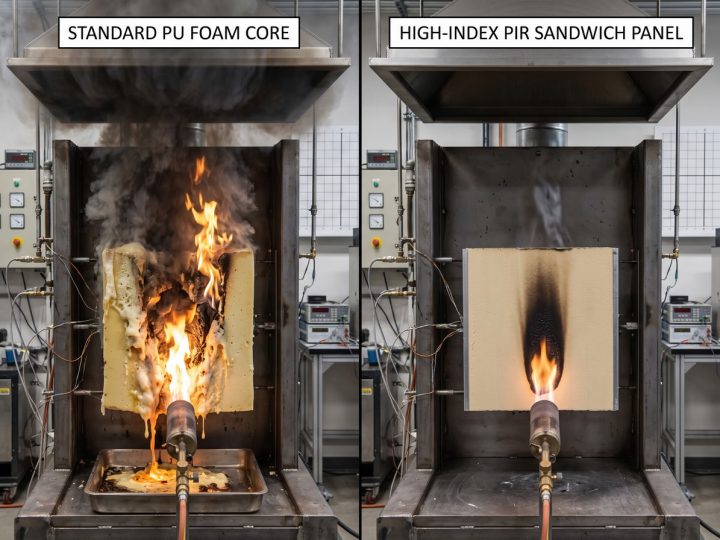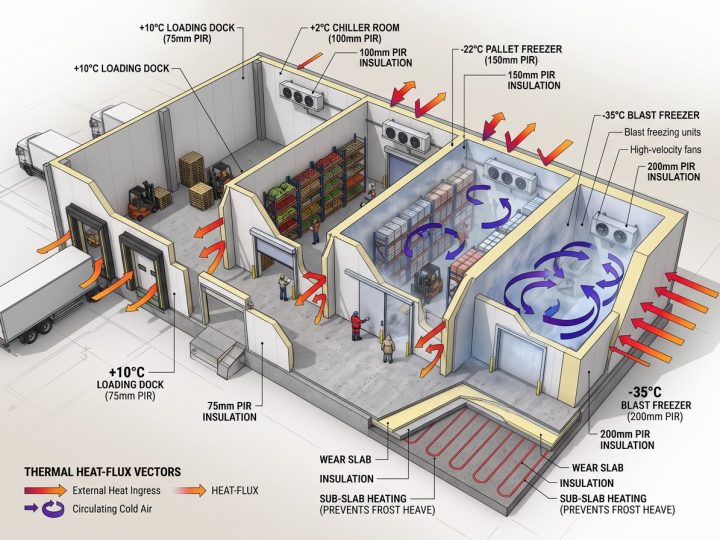
For international EPC contractors, cold-chain developers, and industrial project owners across the Middle East, Southeast Asia, Australia, Europe, and the Americas, sourcing directly from top-tier China sandwich panel manufacturers offers compelling advantages: automated continuous production capacity, complete steel-structure-plus-cladding integration, and 25% to 35% cost savings. However, knowing what to check before buying cold storage panels from overseas suppliers is critical. In the global export market, choosing the lowest-priced quote without verifying manufacturing quality standards frequently results in delaminated facades, rusted sheets, and leaking freezer joints.
| Critical Overseas QC Checkpoint | Unscrupulous Low-Bid Supplier Trap | hihsteel.com Export-Grade QC Standard |
| Steel Skin Thickness & Zinc Mass | Negative tolerance (0.35mm skin, Z60 zinc) | True positive gauge (0.50–0.80mm, Z275 / AZ150) |
| PIR Core Density & Void Limit | Under-blown 32 kg/m³ foam with >10mm voids | 42–45 kg/m³ uniform density (Pores ≤ 3mm) |
| Peel Tensile Bond Strength | Weak < 0.05 MPa (Delaminates under sun) | Certified ≥ 0.10 – 0.14 MPa (Corona + primer bond) |
| Tongue-and-Groove Joint Tolerance | Loose > 2.5mm gap (Severe cold air bleed) | Precision CNC roll-formed (Gap ≤ 1.0–1.5mm) |
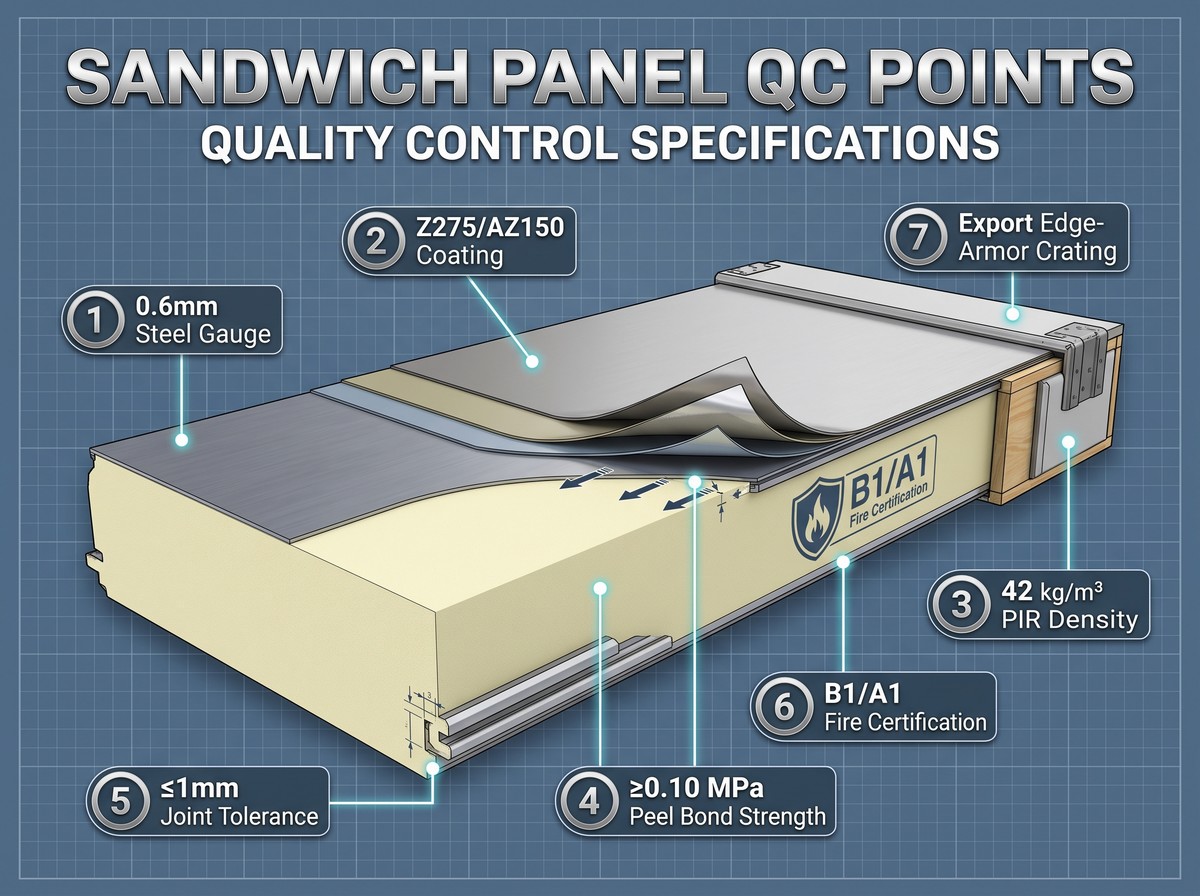
To protect your investment, every overseas procurement contract must enforce European standard EN 14509 (https://www.tecnalia.com/en/news/insulating-panels-with-ce-marking-according-to-en-14509) and seven factory quality control checkpoints. First, audit the steel substrate and coating: unscrupulous suppliers quote 0.50mm steel but deliver 0.38mm negative-tolerance sheets with thin Z60 zinc coatings that rust within 24 months. As detailed in technical sourcing guides at hihsteel.com Instruction and Blogs, buyers must specify net substrate thickness (0.50mm to 0.80mm), Z275 galvanized or AZ150 Galvalume mass, and 20–25µm HDP or 70% PVDF coatings.
Second, verify core density, cellular uniformity, and tensile bonding strength. For PIR/PU cold storage panels, core density must be batch-tested at 40 to 45 kg/m³; under-blown foam (<35 kg/m³) shrinks under sub-zero temperatures. Cut edges must show zero large air pockets (bubble pores strictly ≤ 3mm diameter, ≤ 5mm depth). Crucially, universal testing machine peel pulls must confirm a steel-to-core tensile bond strength ≥ 0.10 MPa (100 kPa). For rock wool panels, insist on natural basalt wool (acidity coefficient MK ≥ 1.8, vertical fiber tensile strength ≥ 160 kPa) rather than corrosive blast-furnace slag wool.
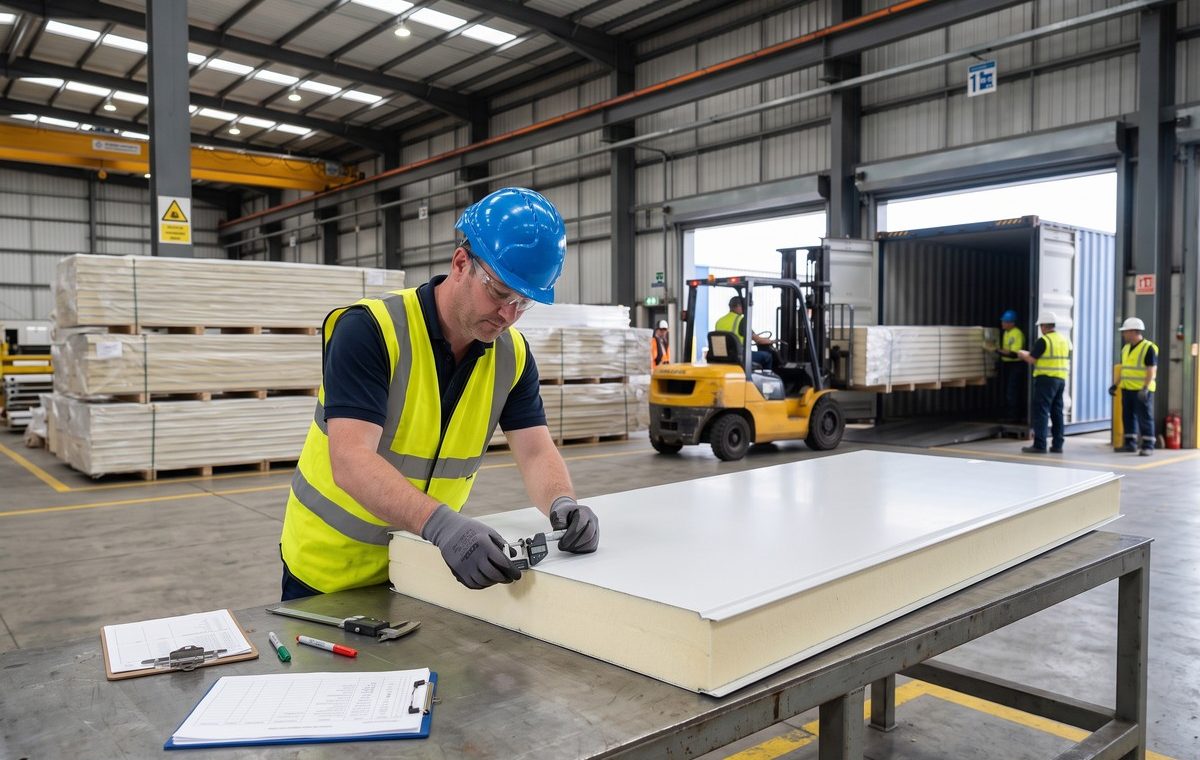
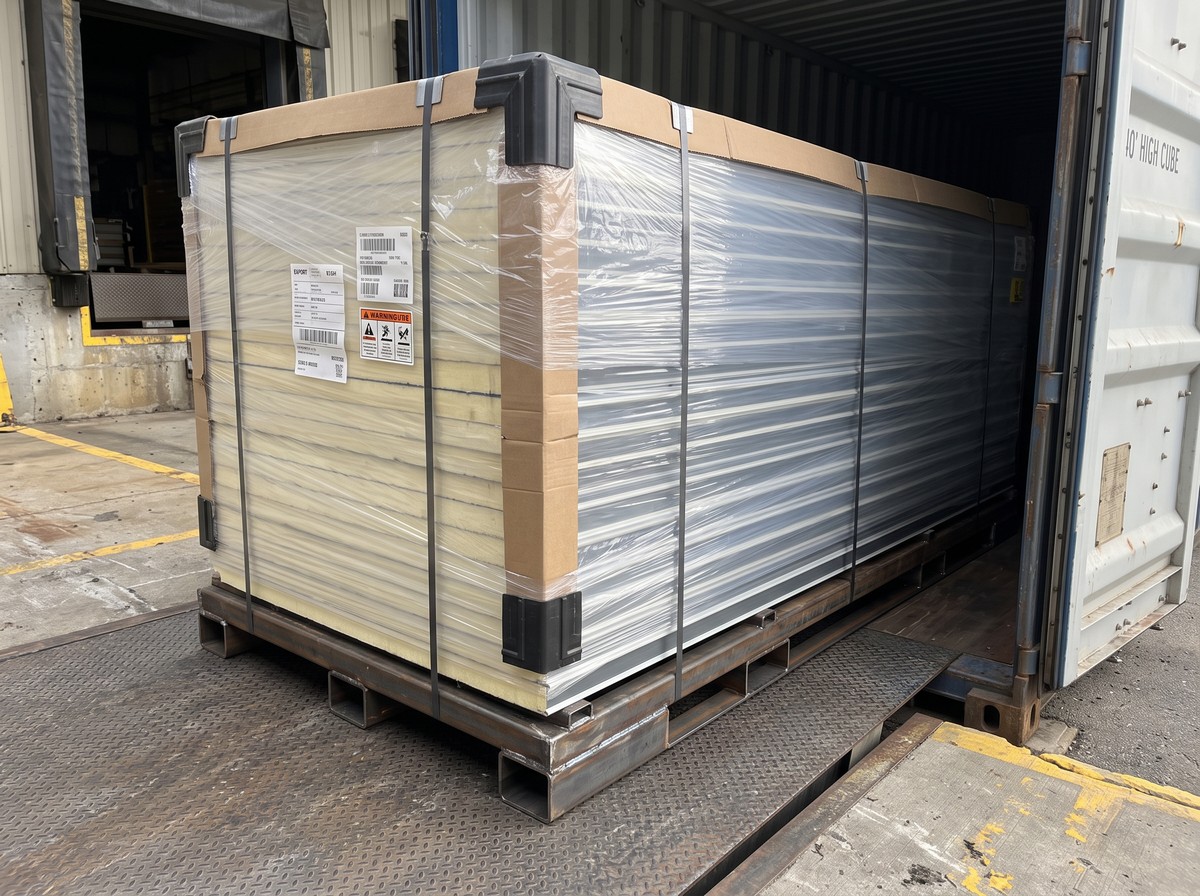
Finally, evaluate trial assembly tolerances and export sea-freight packaging. Before container loading, panels should undergo flat-bed trial joint fitting to confirm tongue-and-groove gaps remain ≤ 1.0mm (architectural) to ≤ 2.0mm (cold room) with step misalignment ≤ 1.0mm. Across global project deliveries documented at hihsteel.com Project References, export-grade packaging includes 60µm UV-resistant protective PE surface film, reinforced edge armor boards, steel-pallet skids, and container loading diagrams—ensuring 100% damage-free arrival at your jobsite.
Frequently Asked Questions (Top 5 Google Search Q&As):
Q: What are the most common mistakes buyers make when sourcing sandwich panels from overseas?
A: The three costliest mistakes are: (1) failing to specify ‘zero negative tolerance’ on steel skin thickness and zinc coating mass (receiving 0.40mm Z60 instead of 0.50mm Z275); (2) not verifying PIR foam core density (receiving 34 kg/m³ foam that shrinks in freezers); and (3) neglecting to include flashing trims, butyl sealants, and cam-lock accessories in the same shipment.
Q: What quality standards and test reports should I request before paying the final balance?
A: Before shipment release, request: (1) Mill Test Certificates (MTC) for steel coils showing base metal thickness, Z275/AZ150 coating mass, and paint system; (2) Lab batch logs for core density, thermal conductivity (ASTM C518), and peel tensile strength (≥0.10 MPa per EN 14509); (3) Fire test certificates (EN 13501-1 or GB 8624); and (4) Pre-shipment photos/videos of micrometer checks and trial joint assembly.
Q: How are sandwich panels packed to prevent dents and scratches during ocean freight?
A: Export-grade packaging applies a 50–60µm adhesive PE protective film to both metal faces during lamination, stacks panels onto structural steel or fumigation-free timber skids, wraps the entire bundle in waterproof shrink film, reinforces all four long edges with rigid (corner armor boards), and secures bundles inside 40HQ containers to prevent shifting at sea.
Q: How many square meters of sandwich panels fit into a 40ft High Cube (40HQ) container?
A: Container capacity depends on panel thickness: a 40HQ container holds approximately 1,100–1,200 m² of 50mm panels, 750–800 m² of 75mm panels, 550–600 m² of 100mm panels, 360–400 m² of 150mm panels, and 260–300 m² of 200mm cold storage panels.
Q: Can an overseas manufacturer supply a complete turnkey package including steel structure, panels, and cleanroom/cold room doors?
A: Yes. Integrated manufacturers like Shandong Hihsteel (hihsteel.com) fabricate primary portal steel frames, Z/C purlins, insulated wall and roof panels, flashings, and matching cleanroom or cold storage doors/windows under one roof—eliminating multi-vendor coordination delays and interface clashes on site.