When procuring insulated envelopes for refrigerated warehouses, food processing plants, and logistics centers, one question consistently tops every buyer’s checklist: PU vs. PIR sandwich panels—which is better for cold storage? At first glance, Polyurethane (PU/PUR) and Polyisocyanurate (PIR) panels look virtually identical on the jobsite. Both are rigid thermoset cellular foams laminated between coated steel facings on continuous lines. However, as detailed in polymer materials research published by the American Chemical Society (ACS) (https://pubs.acs.org/aaemdr/article/3/7/2087/3660238/Design-and-Fabrication-of-Polyisocyanurate-Foams) and guidance from the Engineered Panels in Construction (EPIC) association (https://epic.uk.com/working-with-insulated-panels/insulated-panels-ce-marking/sandwich-insulated-panels/), their internal molecular architectures perform radically differently under fire and extreme thermal stress.
| Technical & Safety Parameter | Standard Polyurethane (PU / PUR) Core | High-Index Polyisocyanurate (PIR) Core |
| Isocyanate Index (MDI to Polyol Ratio) | Low index (105 – 120, Urethane linkages) | High index (250 – 300+, Isocyanurate rings) |
| Thermal Decomposition Temperature | Softens & melts at ~100°C – 120°C | Withstands up to 150°C – 200°C (Chars in place) |
| Fire Rating & Smoke Behavior | B2 / B3 (Rapid flame spread, heavy black smoke) | Certified B1 / EN 13501 B-s1, d0 (Self-extinguishing) |
| Aged Thermal Conductivity (ASTM C518) | 0.022 – 0.024 W/(m·K) | 0.019 – 0.021 W/(m·K) (Finer closed-cell matrix) |
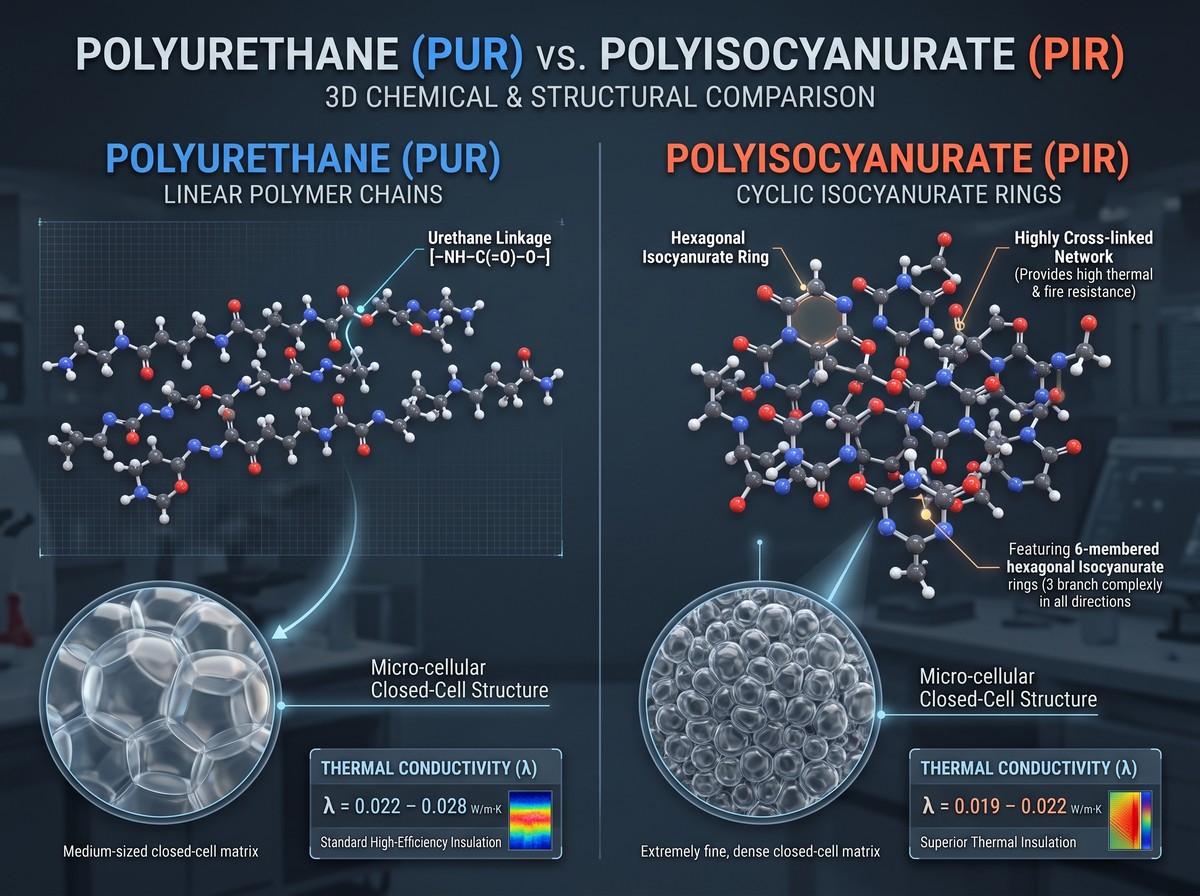
Standard Polyurethane (PU) is produced by reacting roughly equal stoichiometric parts of polymeric MDI (isocyanate, index 105–120) and polyether polyol. The resulting linear urethane chemical bonds offer excellent adhesion and low thermal conductivity, but those linear bonds break down rapidly at temperatures between 100°C and 120°C. In a warehouse fire, standard PU foam melts, releases dense toxic smoke, and propagates flames across ceiling plenums.
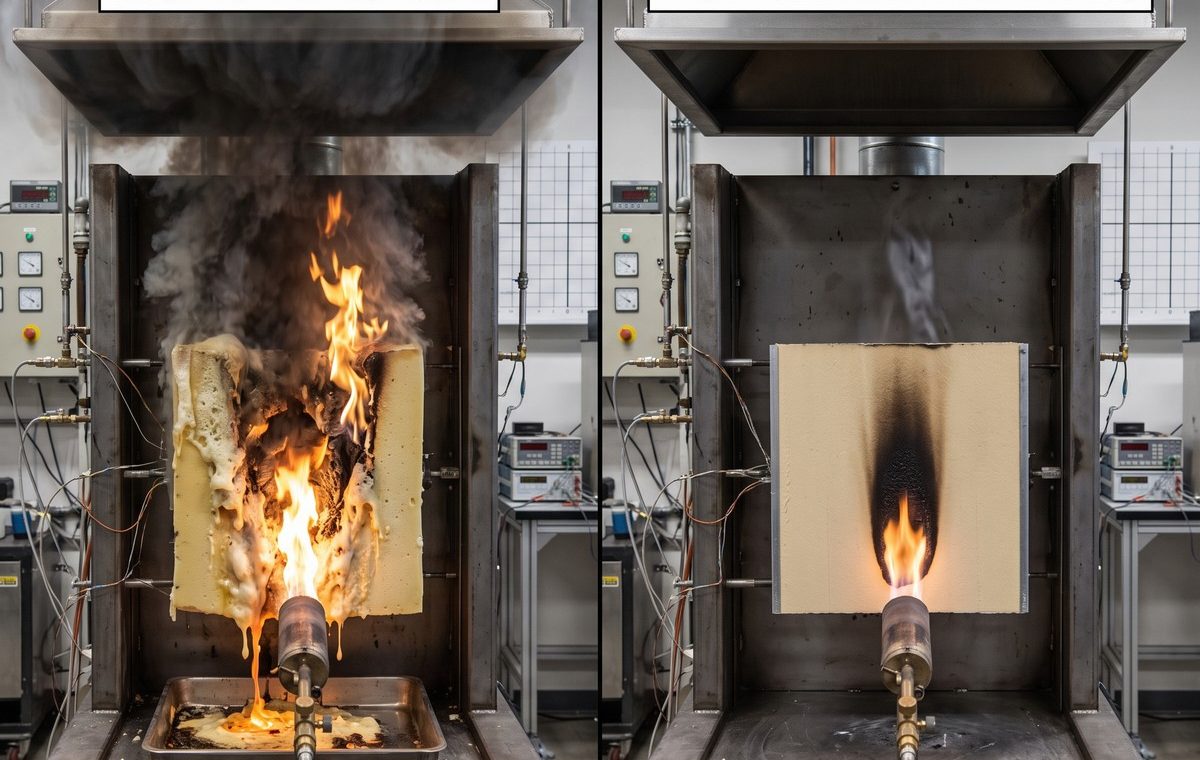
Polyisocyanurate (PIR), by contrast, uses a much higher ratio of MDI (isocyanate index 250 to 300+) combined with specialized trimerization catalysts. Instead of weak linear chains, three isocyanate molecules lock together into ultra-stable six-membered cyclic isocyanurate rings. When exposed to intense fire, PIR does not melt or drip flaming droplets; instead, its surface immediately converts into a rigid, carbonaceous char shield that starves the underlying core of oxygen and blocks heat transfer. This enables PIR panels to achieve EN 13501-1 B-s1, d0 and GB 8624 Class B1 flame-retardant certification—a mandatory prerequisite for commercial property insurance underwriters.
Beyond fire safety, PIR outperforms PU in cryogenic dimensional stability and thermal efficiency. Manufactured using eco-friendly n-pentane blowing agents on automated continuous lines at hihsteel.com Sandwich Wall Panels, high-index PIR generates finer micro-cells (≥ 95% closed-cell ratio), delivering an aged thermal conductivity down to λ ≤ 0.020 W/(m·K) and resisting core shrinkage across temperatures from -70°C to +140°C. While PIR carries a modest 8% to 12% raw material premium over basic PU, it pays for itself immediately through lower insurance premiums, 10% thinner wall requirements, and superior 30-year thermal retention.
Frequently Asked Questions (Top 5 Google Search Q&As):
Q: What is the chemical difference between PU (PUR) and PIR sandwich panels?
A: Both use MDI (isocyanate) and polyol, but PU uses a 1:1 balanced ratio that forms linear urethane chains, whereas PIR uses an excess of MDI (index >250) with trimerization catalysts to form cyclic six-membered isocyanurate rings. These cyclic rings have much higher bond energy, giving PIR superior fire resistance and thermal stability.
Q: Why do cold storage property insurance companies require PIR panels instead of standard PU?
A: Global commercial insurers (following FM Global and LPCB guidelines) penalize or refuse coverage for standard PU panels because linear polyurethane melts and spreads fire inside concealed cavities. PIR panels char in place, self-extinguish upon flame removal, produce minimal smoke (B-s1, d0 / Class B1), and prevent catastrophic warehouse fire losses.
Q: Does PIR have better thermal insulation (R-value) than PU?
A: Yes. Because continuous pentane-blown PIR forms smaller, more uniform closed micro-cells (≥ 95% closed-cell content), its aged thermal conductivity reaches 0.019–0.021 W/(m·K), compared to 0.022–0.024 W/(m·K) for standard PU—delivering roughly 8% to 10% higher R-value at the exact same thickness.
Q: How much more do PIR sandwich panels cost compared to standard PU panels?
A: Because PIR requires a higher proportion of polymeric MDI and higher-temperature double-belt curing (60°C–70°C), raw panel prices are typically 8% to 12% higher than standard PU. However, when factoring in reduced panel thickness, lower HVAC electricity bills, and 20%–40% lower annual fire insurance premiums, PIR has a much lower total cost of ownership.
Q: How can buyers visually verify on-site whether a supplier delivered true PIR or cheap PU?
A: Perform a simple portable torch burn test on a core off-cut: true high-index PIR immediately forms a rigid black carbon char shield on the surface without dripping molten plastic, and self-extinguishes within 2–3 seconds after the torch is removed. Cheap B3/B2 PU continues burning, melts into black liquid drops, and emits heavy black smoke.