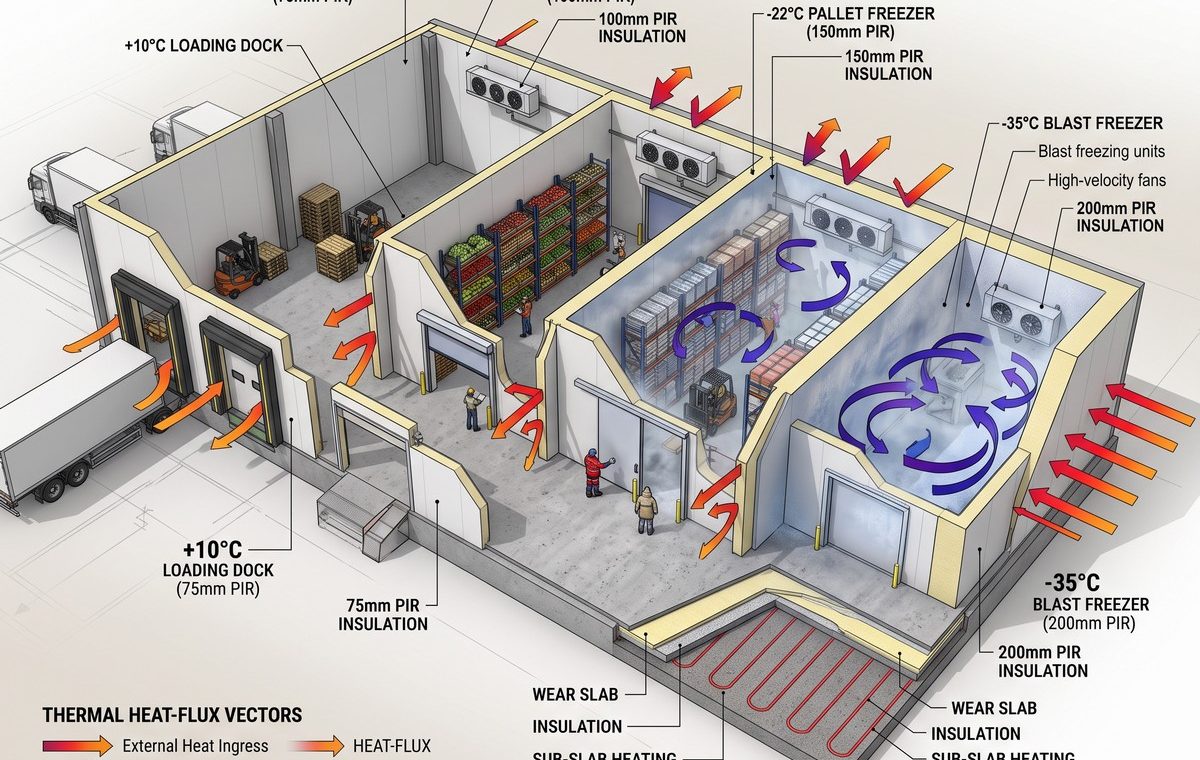
When designing wall and roof sandwich panels for cold storage construction projects, panel thickness is the single most consequential specification impacting both initial capital expenditure (CAPEX) and 30-year operational electricity costs (OPEX). In temperature-controlled engineering, insulation thickness is never guessed—it is calculated to limit maximum steady-state conductive heat flux to 8 to 10 W/m² across the envelope, preventing exterior surface condensation while keeping refrigeration compressors running at peak thermodynamic efficiency.
| Cold Storage Temperature Zone | Recommended PIR/PU Panel Thickness | Target Thermal U-Value & Typical Application |
| Cooler / Staging (+5°C to +15°C) | 50 mm – 75 mm (R-18 to R-26) | U ≤ 0.28 – 0.40 W/m²K (Produce prep, loading docks) |
| Chiller / Pharma (+0°C to +5°C) | 75 mm – 100 mm (R-26 to R-35) | U ≤ 0.20 – 0.26 W/m²K (Dairy, vaccines, fresh meat) |
| Holding Freezer (-18°C to -25°C) | 120 mm – 150 mm (R-42 to R-52) | U ≤ 0.14 – 0.17 W/m²K (Frozen food, seafood hubs) |
| Deep / Blast Freezer (-30°C to -40°C) | 180 mm – 200 mm (R-62 to R-70) | U ≤ 0.10 – 0.12 W/m²K (Tuna deep freeze, ice cream) |
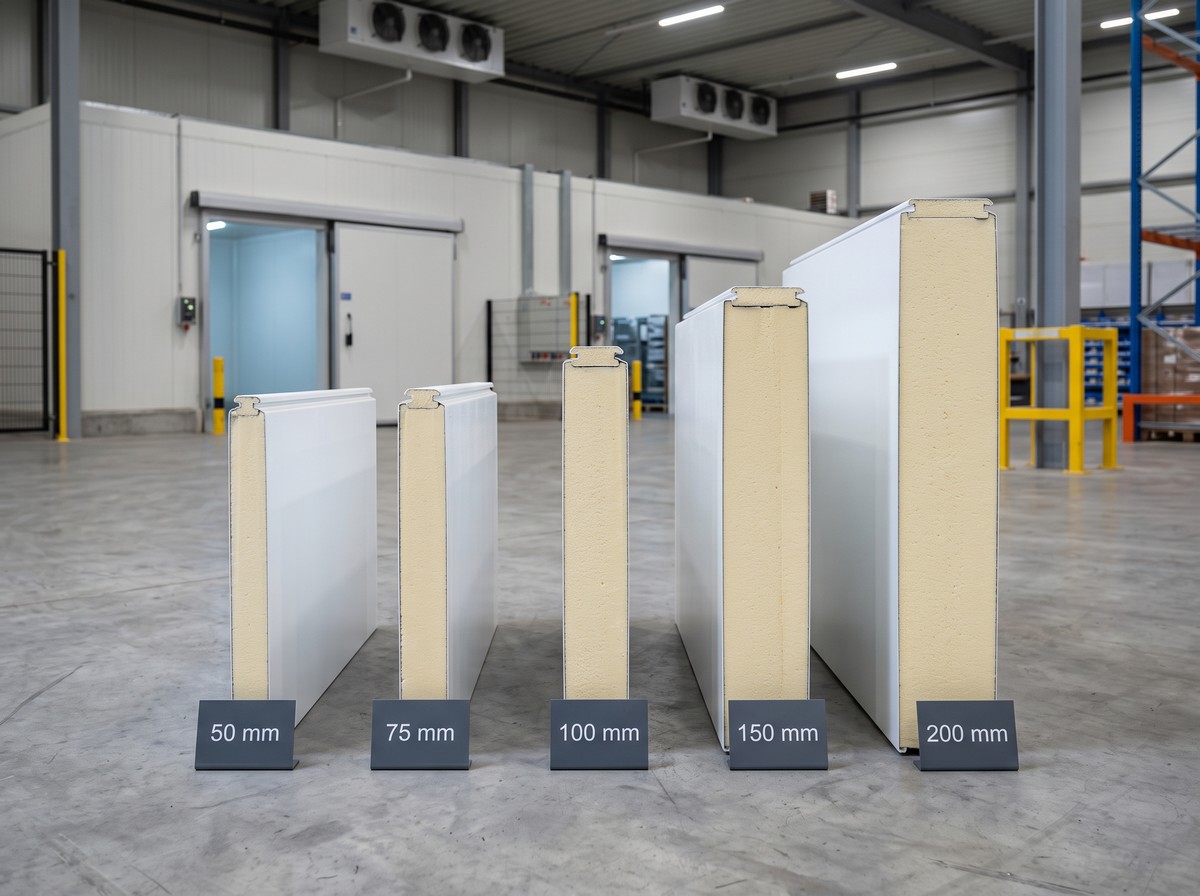
According to steady-state thermal transmission testing standards under ASTM C518 (https://www.polyiso.org/page/R-VALUEMETRICS) and design guidelines from the Global Cold Chain Alliance (GCCA) (https://www.gcca.org/magazine-article/driving-the-cold-chain/), high-index Polyisocyanurate (PIR) and Polyurethane (PU) foam cores (density 40 to 45 kg/m³, aged thermal conductivity λ = 0.020 to 0.022 W/m·K) provide the industry benchmark for thickness sizing. For ambient staging vestibules and fruit/vegetable ripening rooms (+5°C to +15°C), 50mm to 75mm PIR panels provide ample thermal resistance. For standard chillers, beverage cold rooms, and pharmaceutical storage (+0°C to +5°C), 100mm panels are the global standard.
As operating temperatures drop below freezing, water vapor drive and conductive heat gain intensify exponentially. Commercial holding freezers (-18°C to -25°C) storing frozen meat, poultry, and logistics pallets require 150mm PIR wall and ceiling panels (U ≤ 0.14 W/m²K). For deep-freeze pelagic tuna storage, ice cream hardening tunnels, and industrial blast freezers (-30°C to -40°C), specifying 180mm to 200mm continuous PIR panels is mandatory. Undersizing a -30°C freezer with 100mm panels lowers the exterior steel skin temperature below the ambient dew point, causing persistent outer-wall sweating, ice lensing inside joints, and a 35%+ surge in refrigeration power bills.
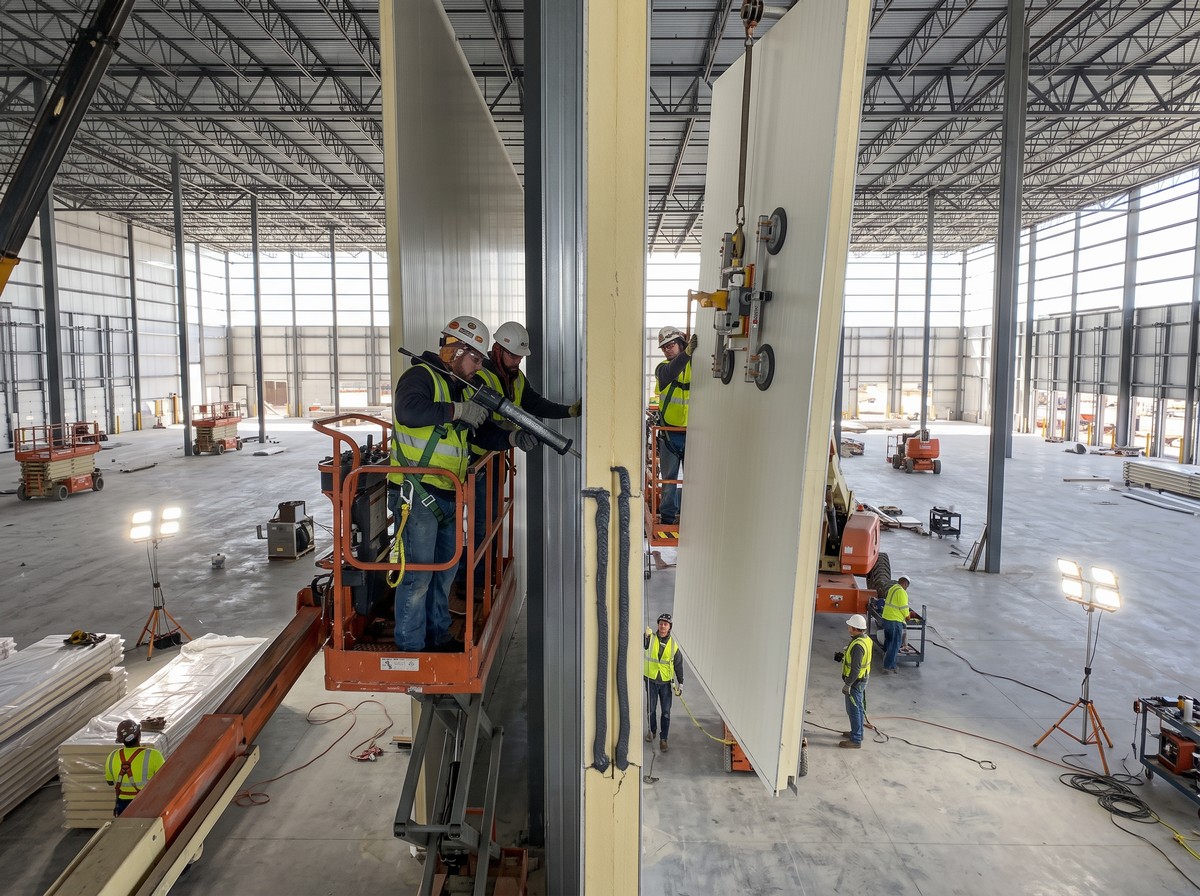
Roof envelopes in cold storage construction require special attention. Because solar radiation heats exterior roofs up to +70°C in summer, cold storage roof sandwich panels and Sandwich Wall Panels should be specified 20mm to 25mm thicker than side walls, or deployed in a dual-envelope design (an outer weather-tight standing-seam roof above an internal suspended PIR ceiling deck) to eliminate solar thermal shock.
Frequently Asked Questions (Top 5 Google Search Q&As):
Q: What thickness of PIR sandwich panel do I need for a -20°C walk-in or warehouse freezer?
A: For a -18°C to -25°C commercial freezer, 120mm to 150mm PIR/PU sandwich panels are recommended for interior and exterior walls, and 150mm to 180mm panels are recommended for ceilings/roofs exposed to solar heat gain. This keeps heat flux below 10 W/m² and prevents exterior condensation.
Q: Why should cold storage roof panels be thicker than wall panels?
A: Direct sunlight can heat an exterior roof surface to +65°C to +80°C—creating a temperature differential of nearly 100°C above a -20°C freezer interior. Specifying roof panels 25mm thicker than wall panels, or using a white reflective PVDF finish with a ventilated attic plenum, prevents excessive ceiling heat gain.
Q: Can I use EPS sandwich panels instead of PIR/PU for a sub-zero freezer?
A: EPS has a higher thermal conductivity (λ ≈ 0.038 W/m·K vs. 0.020 W/m·K for PIR) and higher water vapor permeability. To match the R-value of a 150mm PIR panel, an EPS panel would need to be nearly 280mm thick, and its B2/B3 combustibility fails most commercial cold storage fire codes. PIR is strongly preferred.
Q: How do you prevent thermal bridging at the corners and floor junctions of a cold room?
A: Thermal bridges are eliminated by cutting outer metal skins at corner miters (leaving continuous foam-to-foam contact injected with expanding PU foam), installing PVC thermal-break profiles around doors, and laying 150mm high-compressive PIR/XPS floor insulation with under-floor frost-heave heating mats.
Q: What is the maximum single-piece length for shipping cold storage wall panels overseas?
A: To fit inside standard 40-foot High Cube (40HQ) ocean shipping containers, panels are typically cut to maximum lengths of 11.80 to 11.95 meters. For taller high-bay warehouses, panels are engineered with horizontal thermal-break expansion joints.