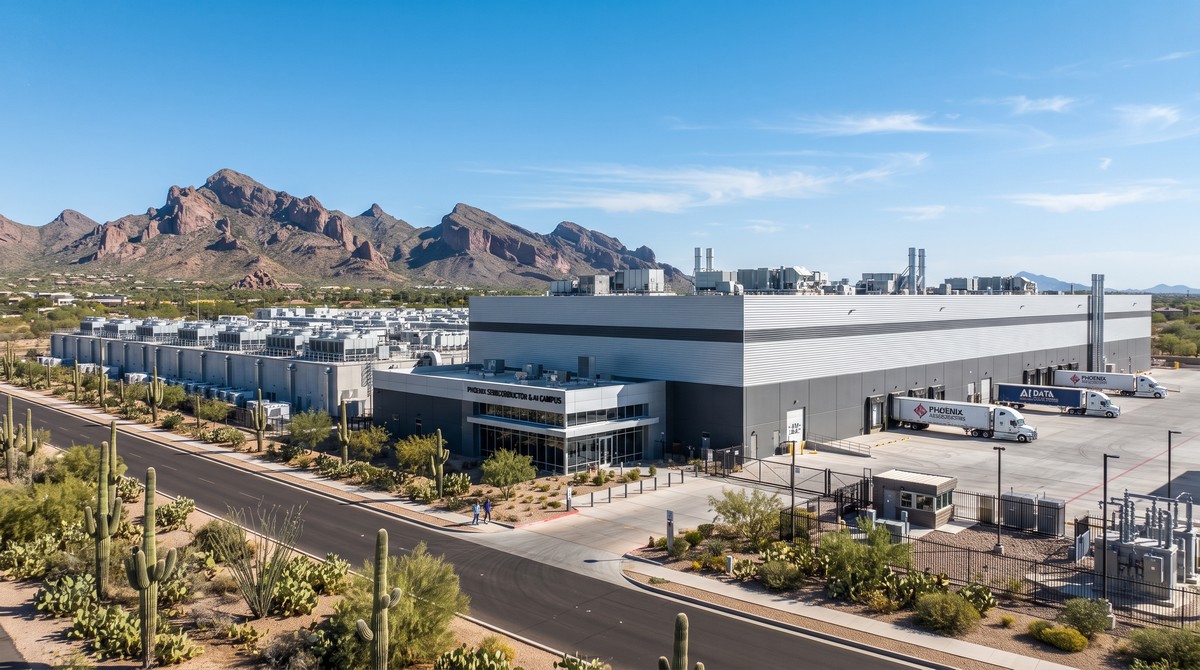
The Phoenix metropolitan area in Arizona—famously known as the ‘Silicon Desert’—has emerged as the undisputed epicenter of North America’s advanced semiconductor and hyperscale data center boom. Driven by multi-billion-dollar investments from global chipmakers and hyperscale cloud providers, Maricopa County is seeing dozens of square miles of advanced infrastructure break ground. However, according to regional climate engineering assessments and global industrial envelope market data from Research and Markets (https://www.researchandmarkets.com/reports/6035425/steel-structure-market-report), building in the Sonoran Desert presents an unforgiving thermal battlefield: prolonged summer ambient temperatures exceeding +48°C (+118°F) and extreme solar surface radiation baking roof surfaces up to +80°C.
| Desert Envelope Engineering Metric | Traditional Tilt-Up Concrete Wall | High-Index PIR & Aluminum Honeycomb System |
| Solar Thermal Heat Gain Resistance | Low thermal inertia, severe heat soak | Continuous R-35 to R-45 (λ ≤ 0.020 W/m·K) |
| Building Envelope Air Infiltration | 0.25 – 0.40 cfm/ft² at joints | < 0.01 cfm/ft² (Dual elastomeric factory seals) |
| Ceiling Walkability & MEP Servicing | Separate heavy steel catwalk grid | Integrated walkable deck (Point load ≥ 150 kg) |
| HVAC Cooling Power Consumption | High parasitic compressor load | Cuts cooling energy by 30% to 35% (Sub-1.2 PUE) |
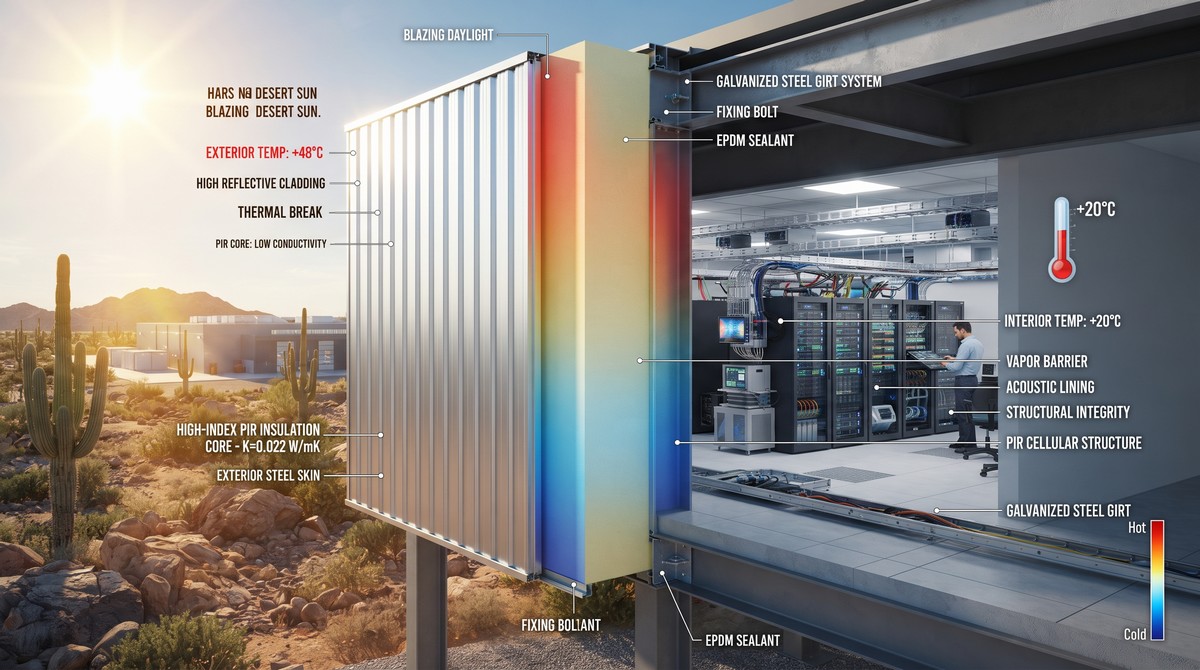
In this scorching climate, conventional tilt-up concrete walls and site-built drywall partitions impose a crippling energy penalty. Concrete absorbs immense sensible heat during the day and radiates it directly inward into server halls and clean sub-fabs throughout the night. This thermal soak overwhelms chilled-water loops, driving data center Power Usage Effectiveness (PUE) ratings dangerously above environmental targets. Furthermore, desert dust storms (haboobs) drive fine silica particulate into micro-cracks in unsealed concrete expansion joints.
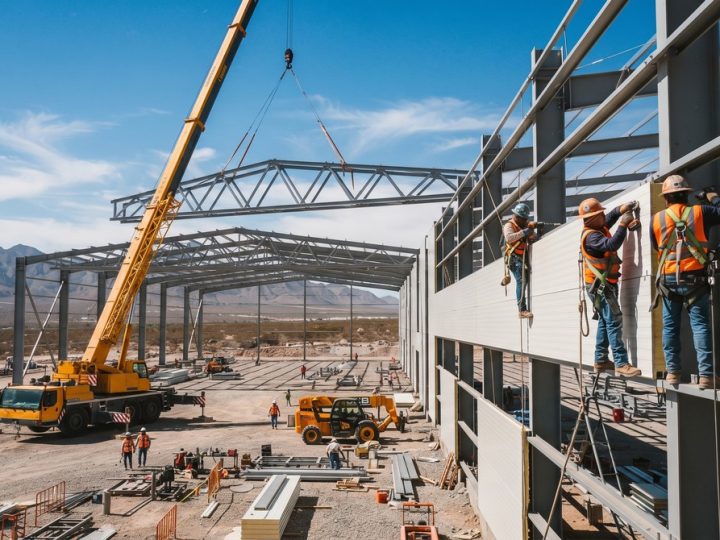
Polyisocyanurate (PIR) sandwich wall and roof panels provide the ultimate thermal shield. Featuring automated continuous n-pentane blowing technology, high-index PIR cores achieve ultra-low thermal conductivity (λ ≤ 0.020 W/m·K) and a continuous R-value exceeding R-35 at 100mm thickness. Precision tongue-and-groove interlocking joints embedded with factory-compressed dual silicone gaskets seal the building against exterior haboob dust storms while maintaining building air infiltration below 0.01 cfm/ft² under ASTM E283 standards.
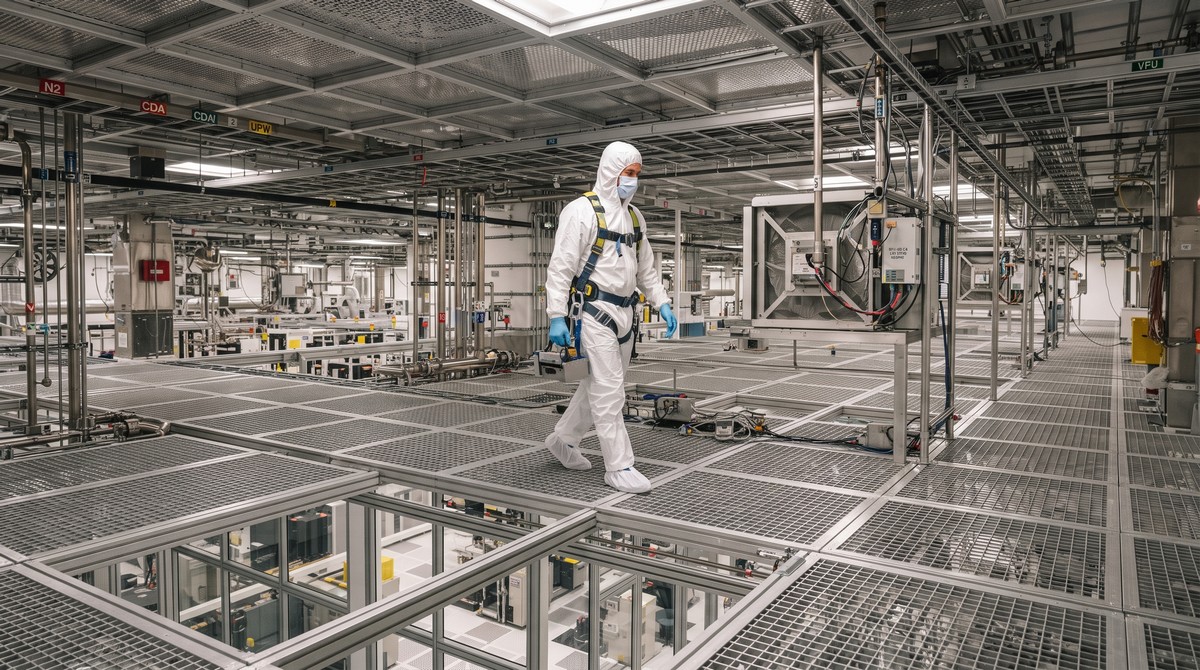
For Phoenix’s colossal semiconductor cleanrooms, interior ceiling architecture requires structural agility. Housing thousands of Fan Filter Units (FFUs) and automated material handling system (AMHS) overhead wafer tracks, hihsteel.com Clean Room Series (https://hihsteel.com/category/product/) supplies heavy-duty walkable aluminum honeycomb ceiling panels. Weighing only 10 to 12 kg/m², these panels support concentrated point loads exceeding 150 kg across 1.5-meter spans without micro-vibrations, allowing maintenance engineers to service critical mechanical systems without disrupting sensitive sub-nanometer lithography operations below.
Frequently Asked Questions (Top 5 Google Search Q&As):
Q: How do data centers handle extreme summer heat (+48°C) in the Phoenix metropolitan area?
A: Phoenix data centers handle extreme desert heat by pairing closed-loop waterless liquid cooling with high-performance building envelopes. Continuous PIR sandwich wall and roof panels (100mm–150mm thick, R-30 to R-45) eliminate thermal bridging and block solar radiant heat gain. Precision double-gasketed interlocking joints prevent hot air infiltration, keeping facility PUE strictly below 1.2.
Q: What insulation core is best for semiconductor cleanroom envelopes in Arizona’s desert climate?
A: For exterior envelope walls, high-index closed-cell PIR foam is preferred for its ultra-low thermal conductivity (λ ≤ 0.020 W/m·K). For interior photolithography cleanrooms and walkable ceilings, aerospace-grade aluminum honeycomb is mandatory because it is 100% inorganic, generates zero chemical outgassing (AMC-free), and provides exceptional flexural rigidity under thermal stress.
Q: Why are walkable clean room ceilings essential in Phoenix semiconductor megafabs?
A: Semiconductor cleanrooms operate thousands of Fan Filter Units (FFUs) and automated material handling system (AMHS) wafer tracks above the ceiling plane. Walkable ceiling panels (point-load capacity ≥ 150 kg, uniform load ≥ 250 kg/m²) allow MEP technicians to walk directly on the ceiling deck to perform continuous maintenance without setting up ladders or disrupting clean production below.
Q: How do insulated metal panels prevent dust infiltration during Arizona desert haboobs (dust storms)?
A: Insulated metal panels feature continuous hot-dip galvanized steel skins and precision-milled tongue-and-groove joints with pre-installed elastomeric EPDM/silicone compression gaskets. When fastened to structural steel girts, the joints compress into an airtight seal (air leakage < 0.01 cfm/ft² per ASTM E283), completely blocking sub-micron desert dust.
Q: What building codes govern industrial envelope insulation in Maricopa County and Phoenix?
A: Industrial buildings in Phoenix must comply with the International Energy Conservation Code (IECC) and ASHRAE 90.1 standards for Climate Zone 2B (Hot and Dry). These standards mandate continuous insulation (c.i.) with minimum R-values of R-25 to R-35 for roofs and R-20 to R-28 for walls, which is most cost-effectively achieved using pre-engineered sandwich panels.