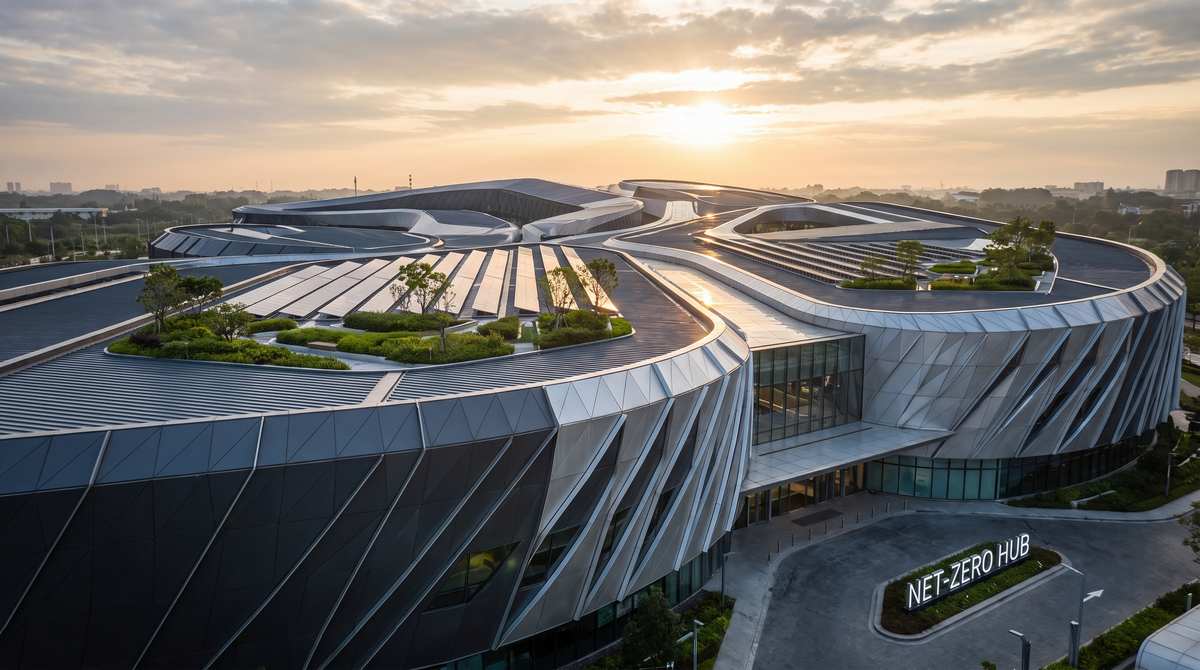
With international sustainability standards—including the EU Energy Performance of Buildings Directive (EPBD) and North American ASHRAE 90.1—aggressively tightening toward Net-Zero Energy Buildings (NZEB), building envelope performance has become the decisive factor in industrial asset valuation. As documented in macro-industry reports from Future Market Insights (https://www.futuremarketinsights.com/reports/metal-structural-insulation-panels-market) and global research published by Grand View Research (https://www.grandviewresearch.com/industry-analysis/structural-insulated-panels-market), property owners can no longer meet stringent energy efficiency targets by merely adding thickness to legacy insulation materials. Structural dead load, wall depth restrictions, and ocean freight costs demand an advanced material with unprecedented thermal resistance per millimeter: continuous high-index Polyisocyanurate (PIR).
| Physical & Thermal Metric | Standard Rock Wool Sandwich Panel | High-Index PIR Sandwich Panel |
| Thermal Conductivity (λ) | 0.040 – 0.044 W/(m·K) | 0.019 – 0.022 W/(m·K) (Best in Class) |
| Wall Thickness for R-30 | ~ 150 mm (Heavyweight dead load) | ~ 75 mm (50% Space / Weight Savings) |
| Fire Reaction Classification | Class A1 (Inorganic non-combustible) | Class B-s1, d0 (Self-extinguishing) |
| Structural Self-Weight | High (~ 18 – 25 kg/m²) | Ultra-lightweight (~ 10 – 14 kg/m²) |
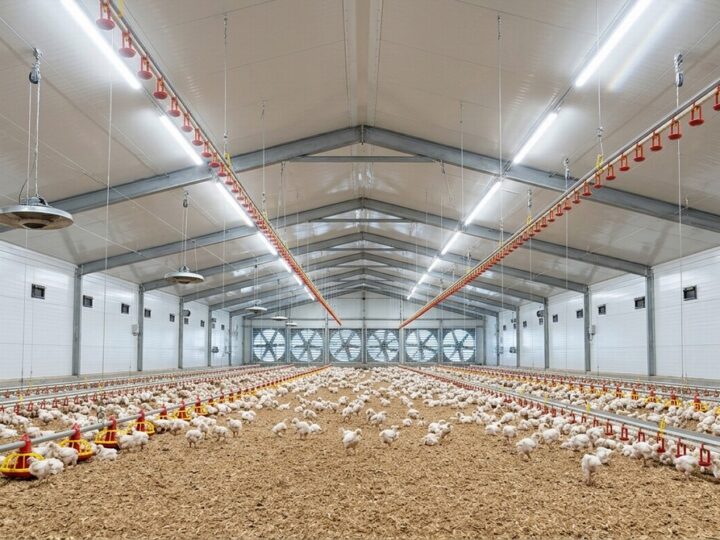
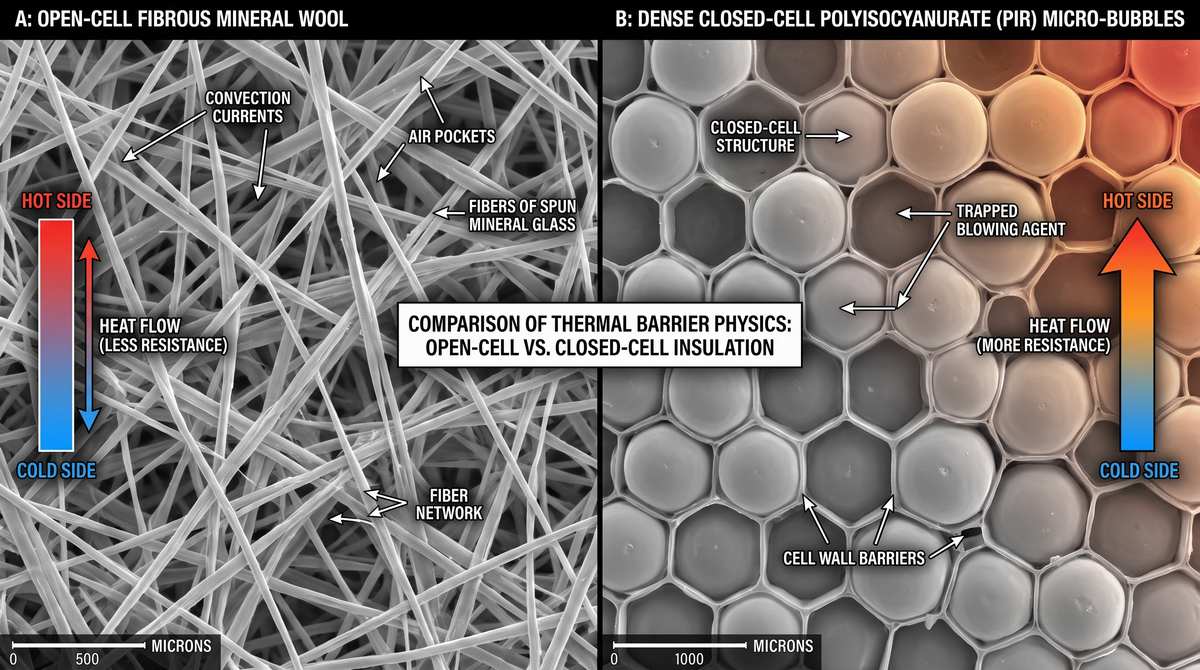
The thermodynamic breakthrough of PIR lies in its highly cross-linked polyisocyanurate ring chemistry. During high-pressure continuous double-belt lamination, the formulation creates a uniform microscopic matrix where over 95% of individual foam cells are completely closed and filled with low-conductivity blowing agents. This achieves a thermal conductivity rating (λ) of 0.019 to 0.022 W/(m·K)—providing more than twice the thermal insulating power of conventional mineral wool and fiberglass at equivalent thicknesses. For a 10,000-square-meter distribution center, specifying PIR wall and roof panels from hihsteel.com Sandwich Roof Panels (https://hihsteel.com/category/product/metal-cladding-systems/sandwich-roof-panels/) reduces building cooling and heating energy consumption by 25% to 35% annually.
Beyond thermal physics, fire performance has been historically misunderstood. Unlike standard polyurethane (PUR) which melts and flows when ignited, polyisocyanurate undergoes a stable thermal charring reaction. When subjected to intense flame exposure, the outer foam surface rapidly forms a dense, carbonaceous protective shield that chokes off oxygen and prevents flame propagation into the core. Premium continuous PIR panels achieve Class B-s1, d0 reaction-to-fire classification under EN 13501-1, generating virtually zero toxic black smoke or burning droplets.
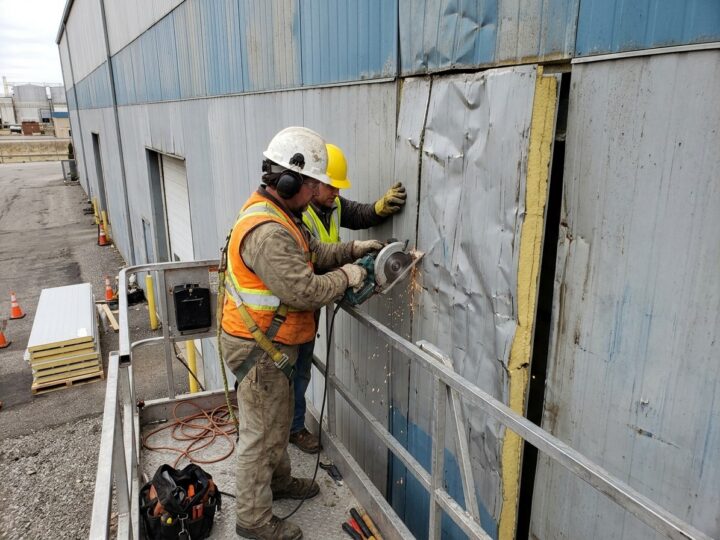
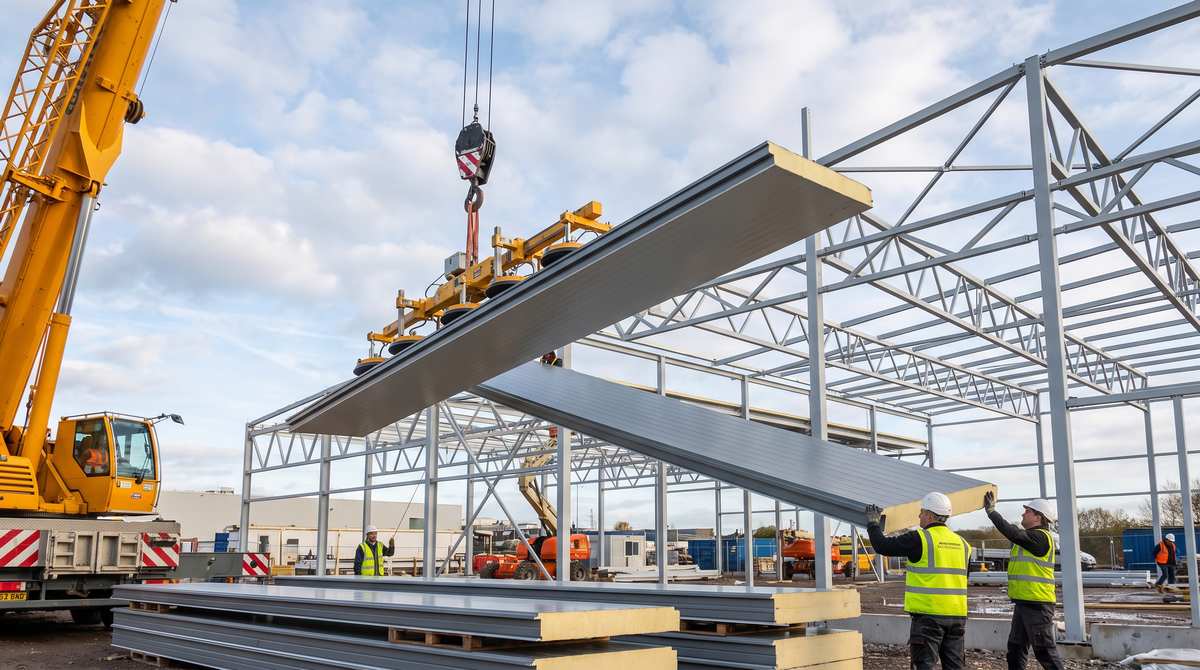
From an EPC installation perspective, the lightweight profile of PIR sandwich systems pays immediate dividends across the structural frame. Cutting panel dead weight by over 40% allows structural engineers to specify lighter cold-formed C/Z secondary purlins and more slender structural steel columns. Paired with hidden-screw overlapping joints and integrated factory-applied capillary grooves, PIR roof panels withstand severe wind uplifts while preventing roof leaks across 20-year operational lifespans. Direct sourcing from high-capacity manufacturing hubs ensures optimized panel lengths cut precisely to fit 40-foot high-cube containers, saving substantial ocean freight costs.